Tuesday, March 31, 2020

La Semaine Dernière A Mes Yeux


(20 mars ---- 27 mars)

Selon un reportage, le gouvernement a décrété les measures de confinement à Gaibandha après une femme rt un homme ont été détectés avec coronavirus positive. 27 personnes ont été détectées avec le virus tueur. A Mirpur, deux personnes ont péri. 5 Bangladais ont aussi péri à l’étranger.

Selon un reportage, la plateforme de hypermarché a ordonné de fermer tous les magasins et hypermarchés à compter de 25 mar4s jusqu’à 31 mars.

Selon un reportage, une université privée à demander explications depuis un chercheur après une etude, où il a contribute , avait trouvé que propagation de coronavirus pouvait tuer Presque 500.000 Bangladais. Dans un communiqué, l’université s’est dit qu’elle n’avait jamais commissionné une etude comme ça.

Selon un reportage, BGMEA, plateforme d’ateliers de confection, s’est dit que les acheteurs étrangers ont annulé commande de $1,68 milliards jusqu’au mercredi.

Selon un reportage, gouvernement a déployé police et l’armée de la terre à traverse de pays pour effectuer les measures de confinement du 26 mars au 4 avril. Dans quelques parts , les policies ont battu des gens qui marchaient en donnant aucune raison satisfaisante. Le chef de la Police a appelé Police de montrer retenue remarquable.

Selon un reportage, l’ambassade de l’Angleterre a impose alerte de voyage et conseillé à ses ressortissants de quitter Bangladesh dès que possible.

Corona And Debt Service Payment


Corona casts shadow over export earning,
It starts alarm bell ringing
Over debt service payment.
Disaster means weak debt management,
Reflected in lower annual installment.
Platform of Bangladesh’s garments exporters, BGMEA, confirmed that $2.87 billion worth of export order cancelled before March 30. Evidently, Coronavirus outbreak unleashes its harming effect on economy. Unarguably, this pandemic may affect more or less all the forex earning sources. Less pledges of foreign assistance are made for the ongoing fiscal year. There is little room for optimism for coming fiscal year. As it appears, our Debt Service Payments may also take a hit because of pandemic crisis.

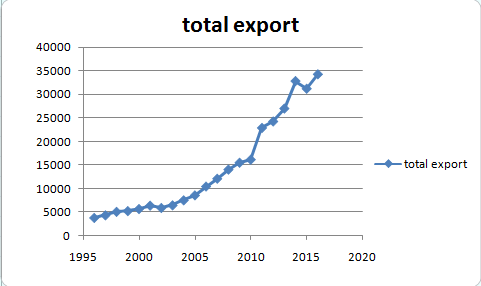
I did a little analysis on debt service payments and total export based on 20-year-long data from 1996 to 2016. Debt Service Payments largely depend on forex earnings. Export is one of the key sources of forex earnings. What kind of influence export has on debt service was what I would like to see. Data gleaned from Bangladesh Economic Review.

As usual, I first went for autocorrelation check. Durbin-Watson statistic was found to be 1.46 for 21 observations and 1 explanatory variable. So there was no autocorrelation. It reported positive autocorrelation


(Source:Bangladesh Economic Review 2018)
Then I went for stationarity check. Visual inspection of both debt service and export series insinuated that they wandered around a trend. So I constructed following regressions:

🔺 Debtt = a + b Debtt-1 + ct
🔺 Exportt = a + b Exportt-1 + ct
Where 🔺 Debtt= Differences in debt services at t,
Debtt-1 = Debt service payments at t-1,
🔺 Export t= Differences in export earnings at t,
Exportt-1= export earnings at t-1,
t = a time trend variable, here year.

Tau statistics of slope coefficients of lagged Debt and Export, -2.435 & -1.248 , in absolute terms were smaller than MacKinnon critical tau statistic at 10% level, -2.584. So I did not reject the null hypothesis that b=0 or Debt and Export show an unit root or they are nonstationary.

To my dismay first differences of Debt and Export did not turn out to be stationary. So both Debt and Export, for the sake of simplicity, were integrated of order d, I(d).

Regressing Debt on Export I got the residuals for cointegration test. Then I ran the following regression:

🔺 Residt = b Residt-1 + c 🔺 Residt-1

The computed tau statistic of lagged residual's slope coefficient, -3.94, was greater than Engle-Granger critical statistic at 5% level in absolute terms, -1.94. So I rejected the null hypothesis of no cointegration or residuals are nonstationary. There was indeed a cointegrating relationship between the two and residuals appeared to be stationary.

This kind of situation, variable were I(d) series and cointegrated, requires a VEC model :

🔺 Debtt = p + q Residt-1+ vtDebt

🔺 Exportt = r + s Residt-1+ vtExport

where Residt-1= lagged residuals obtained from regressing Debt on Export Resulting model looked like this:

🔺 Debtt = 33.083 -0.508 Residt-1(F=2.19, p=0.155)

(t=1.84, p=0.08) (t=-1.48, p=0.155)

🔺 Exportt = 1483.07 + 4.47 Residt-1(F=0.276, p=0.605)

(t=3.334, p=0.033) (t=.525, p=0.605)/>

None of the individual functions and slope coefficients appeared to be significant. However I was eager to see impact of a shock to Export on Debt Service Payments. As usual I depended on Impulse Response Function(IRF), which shows the effect of a shock to an endogenous variable on itself and on other endogenous variables.

An orthogonalized shock to Export revealed that it had permanent effect on Debt Service and it did not die out over time.

Later I turned to see whether disaster years, be it natural or political or international, had any effect on debt service payments. I constructed the following regression function:

lnDebtt = a1 + b Export t+ a2Dt

where lnDebtt = log natural of debt service payments at t,
Export t = export earnings at t
D = 1 for disaster years,
= 0 for normal years.

This model turned out to be significant (F= 90.15, p = 0.00, degree of freedom = 2, 18) Resulting resulting regression function looked like this:

lnDebtt = 6.20 + 0.000028 Export t- 0.0657Dt

The dummy coefficient , however, appeared to be insignificant (t = - 1.50, p = 0.15). Had it been significant, it would be said that debt service payments in disaster years were 6.36% lower than those in normal or calm years.

More or less it is becoming clear that Coronavirus may affect our debt service payments by harming our forex earning sources. Any drop in debt service payments in disaster years may put pressure on subsequent years. As external assistance pledges are not on the surface, government may go for costly options for foreign borrowing coupled with significant scrapping of development projects at home.

Sunday, March 22, 2020

La Semaine Dernière A Mes Yeux


(13 mars --- 20 mars)

Selon un reportage, 10 Bangladais, dont 2 enfants, ont été détectés avec Coronavirus positive. Environ 2394 personnes ont été mises en quarantaine.

Selon un reportage, incendie a détruit des magasins et un atelier de confection à Mirpur-10 samedi midi. Ils vendaient des étoffes jattées par les ateliers de confection.

Selon un reportage, 52 Bangladais ont été incarcérés dans les prisons au Qatar. Ils ont été accusés d’avoir possédé des drogues.

Selon un reportage, Banque mondiale donnera Bangladesh $100 millions pour lutter épidémie de Coronavirus.

Selon un reportage, gouvernement dans un communiqué a décrété que les écoles, lycées et universitaires seraient fermés à compter du 17 mars à nouvel ordre.

Selon un reportage de BBC Bangla, mort d’un soldat de paramilitaire a éveillé les soupeçons de Coronavirus dans le bureau de Bangladesh Computer Council.

Selon un reportage, Coronavirus a ciblé sa premier victim au Bangladesh mercredi, une personne âgé de 70 ans. Il n’est jamais allé à l’étranger. Mais il est venu à la proximité d’un Bangladais qui est retourné depuis étranger.

Selon un reportage, gouvernement a décrété les measures de confinement à Madaripur où la plupart de villageois habitent et travaillent en Italie. De plus, 10 parmi 17 détectées avec Coronavirus appartiennent à cette petite ville.

Mon portable épuise souvent. J'ai assez de difficulté à mettre à jour mon blog site. Je soupçonne que mon portable est devenu victime de hacking.Je suis allé chez mécanicien de portable pour remettre à place le operating software. Mais Je ne peux pas recharger ma batterie souvent. Elle comporte bizarrement. Quelques fois , elle prends la recharge, quelques fois elle nie. Elle reste morte pour 72 heures . Elle ne franchit jamais le seuil de 20% pendant la recharge. De plus j'ai perdu tous mes apps

Oil Price And Current Account Balance


Could drop in oil price augur good for economy?
Searched the answer spending hours many,
Data on current account and crude oil price
Revealed an unpleasant surprise.
Contrary to belief, current account sustained deficit
Slide from $70 may also hurt forex receipt.
IRF says oil price shock has lasting effect,
This time, positive outcome is what I expect.
In international market, crude oil price hit a nadir after two leading producers had failed to reach agreement on production level.

A local news report says it augurs good for Bangladesh Petroleum Corporation, Bangladesh’s biggest corporation with annual turnover of Tk 250 billion, since government will no longer have to subsidize its operations and it will again walk along the profit-making path.

Lower oil price also means cost of import and cost of production will be much lower. This is happening when aggregate demand in the world market is falling. Investment and infrastructure projects are being postponed. However, export orders are also being called off.

I was keen to look at what it means for current account balance (CAB), which registered negative for the last couple of years. I gathered the old crude oil price data from my earlier analysis on BPC profit/loss, delving macrotrend and updated it for $33 / barrel in 2020. I gleaned the data on CAB from Bangladesh Bank website. Data for 2020 were only available for July-December period.

Since crude oil price influences import and export item prices, it is assumed that current account balance depends on crude oil price.

A quick look at the data revealed that between 2010 and 2020, economy witnessed current account deficit when the crude oil price was well below the $70/barrel, a much talked about price to sustain the economies of Middle East. It is contrary to the belief that a fall in crude oil price improves current account balance. I am still in that group of believers. It is also important to note that Bangladesh embarked upon big infrastructure and investment projects in the given period. Maybe that is the reason for big current account deficit. As I was interested to see the impact of crude oil price on CAB, I needed to fit a model.

First, I carried out some diagnostic Check. Time series data called for autocorrelation check. Durbin-Watson statistic (d=1.22 for 11 observations and 1 explanatory variable) fell into indecisive zone. So I went for modified Durbin-Watson check. It reported positive autocorrelation( d=1.22 < du = 1.324).

However, I did not transform the regression to make it generalized difference equation. I worked on the serially correlated data and checked for stationarity. To check for stationarity, following regressions were constructed:

🔺 CABt = a + b CABt-1 + ct + d 🔺 CABt-1
🔺 Crudet = a + b Crudet-1 + ct + d 🔺 Crudet-1
Where 🔺 CABt= Differences at current account balances at t,
CABt-1 = current account balances at t-1,
🔺 Crudet= Differences at crude oil prices at t,
Crudet-1= crude oil price at t-1,
🔺 Crudet-1= Differences at crude oil prices at t-1,
t = a time trend variable, here year.

Tau statistics of slope coefficients of lagged CAB and Crude, -2.33 & -2.3 , in absolute terms were smaller than ADF critical tau statistics at 5% level, -3.4620, and at 1% level , -4.067. So I did not reject the null hypothesis that b=0 or CAB and Crude show an unit root or they are nonstationary.

Please note that first differences of CAB and Crude did not turn out to be stationary. I did not have patience to difference further and to see at what level they became stationary. So both CAB and Crude, for the sake of simplicity, were integrated of order d, I(d).

To check for cointegration, I first regressed CAB on Crude and got the residuals. Then I ran the following regression:

🔺 residt = b residt-1 + c 🔺 residt-1

At 5% level, critical value , reported in J Hamilton’s Time Series Analysis was -3.37. Since computed -2.79 was greater than -3.37, I did not reject the null hypothesis of no cointegration or residuals are nonstationary.

In this case, CAB and Crude were I(d) series and were not cointegrated. So, I went for a VAR model :

🔺 CABt = b1 🔺 CABt-1 + b2 🔺 CABt-2+ b3 🔺 Crudet-1 + b4 🔺 Crudet-2+ vt🔺CAB

🔺 Crudet = c1 🔺CABt-1 + c2 🔺 CABt-2+ c3 🔺 Crudet-1 + c4 🔺 Crudet-2+ vt🔺 Crude

VAR model did not fit well as reported by F( for 🔺CAB F= 0.8960, p= 0.54 and for 🔺Crude F= 0.048 , p= 0.99). However I was keen to see the Impulse Response Function(IRF), which shows the effect of a shock to an endogenous variable on itself and on other endogenous variables.

An orthogonalized shock to Crude was reciprocated once or twice by CAB and it died out seven or eight periods later, as shown in the graph. The effect of Crude oil price shock on CAB did not wither away instantly and lasted for quite some time.

Analyzing the data for the last 10 years, it was noticed that Bangladesh sustained current account deficit for the last couple of years when the oil price was well below $70/barrel. However, current account deficit deteriorated when the crude oil price increased. Check the price rise when $86/barrel became $107/barrel in 2011, $53.72/barrel rose to $55.71/barrel in 2017 and $55.71/barrel increased to $66.87/ barrel in 2018. Two things became clear: first, increase in crude oil price evidently hurt current account balance; second, price below $70/barrel did not always generate a current account surplus.

My understanding of the situation is that prices lower than $70/barrel stall many investment and construction projects in the Middle Eastern countries where many Bangladeshis work. As construction work halts , they may be laid off. Remittances, rescuer of current account balance , may also get affected. In addition, higher oil prices generate revenue for investment in many of the occidental countries, contributing to increase in household income. That means more spending on apparel items , leading more orders for Bangladeshi garment factories. This may not last as that high oil price driven revenue may dry up , hurting investment and household income in those countries. So our apparel export may also take a hit because of this. By the way, this is considered without taking into account the Corona effect.

And from the graph it was seen that any rise or fall in Crude oil price had a lasting effect on the current account balance. Could it be different for this time?

Saturday, March 14, 2020

La Semaine Dernière A Mes Yeux


(06 mars --- 13 mars)

Selon un reportage, COVID-19 se développe au Bangladesh. 3 Bangladais ont été détectés avec coronavirus positive. Ils appartiennent à même famille. 2 hommes sont venus en Italie. À l’occasion de l’année Mujib, centième anniversaire de Bangabandhu, beaucoup d’évènements ne se dérouleront pas. L’évènement principal à terrain national est annulé. Dans un communiqué , le gouvernement a dit que les passagers de vol , issu de six pays: Chine, Corée du Sud, Italie, Iran, Thaïlande et Singapour, seront mis en quarantaine. Selon un reportage, la Banque de dévéloppement de l’Asie a fait un bilan préalable de COVID-19. Pour Bangladesh dans le cas pire, COVID-19 coûtera 1% du PIB,$3 milliards.

Selon un reportage, Bangladesh a été emporté par la panique de Coronavirus. Masques sanitaires et médicaments antiseptiques sont tombés victimes de la panique. L’on ne les trouve pas dans le marché. La bourse de Dhaka s’est écroulée. Elle a perdu 279 points lundi.

Selon un reportage, incendie a ravagé une bidonville au sein de Dhaka. C’est la troisième fois cette bidonville subit les dégâts, issu de l’incendie, dans un an.

Selon un reportage, un deputé bangladais a deposé plainte contre un rédacteur en chef d’un quotidien pour avoir publié reportage sur la corruption des deputés. La plateforme de rédacteurs et Amnesty International ont exprimé soucis.

Selon un reportage, World Justice Project est classé Bangladesh 115ème parmi 128 pays, une baisse de deux places, dans son indexe de la loi.

Selon un reportage, un photographe reste disparu après il a été abdiqué par des gens inconnus. Il a assisté à faire un reportage de corruption sur un deputé.

Pandemic's Effect On LC


Less LC Settled for the last week of January,
Checked data for fabrics, yarn and capital machinery.
Data might be incomplete
Effect of Corona was not neat.
This week I tried to look at the settled LCs of some selected import items in order to get an idea of Coronavirus’ influence on these items.

This time, thanks to Bangladesh Bank website, I managed to get data for January 2020; however, the fifth week data was based on January 24 information. So it is not clear whether the fifth week data captures the whole fifth week or a fraction of it. So it is highly unlikely to say the last week of January data hints on Coronavirus effect.

Similarly , I did not manage to get the data on the first week of February. It was not available at Bangladesh Bank website. Selected import items are rice, fabrics, cotton yarn, capital machinery, other machinery. But I constructed following regression functions for three items:

Total LCi = a + b fabricsi + Di
Total LCi = a + b cottoni + Di
Total LCi = a + b CapMaci + Di
Where Total LCi= Total LC settled in week i;
fabricsi= LC settled for fabrics in week i;
cottoni = LC settled for cotton in week i;
CapMaci= LC settled for Capital Machinery in week i;
Di= 0 for weeks prior to Coronavirus outbreak;
=1 for weeks after Coronavirus outbreak;
Third week of January was identified as the beginning of outbreak. Unfortunately for each of the regression function, individual model did not fit well. Moreover, individual parameter did not turn out to be significant.
Following table reported the stat:
None of the coefficients turned out to be significant at 5% level. Please note no prior diagnostic check was carried out.
So effect of Coronavirus outbreak could not be seen on these items. A visual inspection of the graph shows, settled LCs for all the items registered decline in fifth week. However, it was not known whether the decline was stemming from non-availability of complete data or coronavirus effect.

Saturday, March 7, 2020

La Semaine Dernière A Mes Yeux


(29 février --- 06 mars)

Selon un reportage, RAB a extrajudiciairement tué 7 voleurs présumés près de la frontière entre Bangladesh et Birmanie.

Selon un reportage, International Narcotics Control Board de l'ONU a décrit l'état de Bangladesh comme «inquiétant ». Le rapport a mis l'accent sur qu'en 2018 53 millions de «yaba» ont été saisis par les forces de l'ordre.

Selon un reportage, 5 Bangladais qui révélaient symptômes de Covid-19 ont été mis en quarantaine dans un hôpital. Le porte-parole de l'IECDR affirme qu'il n'y a pas d'inquiétude.

Selon un reportage, escarmouche entre la force frontière et les villageois a laissé 5 personnes mortes dont 1 soldat de la force frontière.

Selon un reportage, chaque année presque 7,53 milliards ont été blanchis depuis Bangladesh. Dans son rapport, Global Financial Integrity a divulgué cette info.

Selon un reportage, l'ONU a demandé $870 millions pour aider les Rohingyas au Bangladesh. Les États-Unis ont affirmé que le pays donnerait $60 millions pour les Rohingyas cette année.

Selon un reportage, 4 étudiants de Bangladesh Agricultural University restent disparus après ils sont allés en Arabie Saoudite pour faire le hajj.

Selon un reportage, le secrétaire norvégien des Affaires étrangères est entré en pourparlers avec son homologue bangladais sur les tarifs arriérés contestés de Grameenphone, où la société norvégienne détient les actions. Telenor , un jour plus tard, dans un communiqué a dit que la société télécom de Norvège allait licencier 15% de ses salariés dans les mois qui viennent.

Selon un reportage, Netra News a fait un reportage sur appel d' al-qaïda à ses fidèles à l'intérieur de l'armée bangladaise de mener attaque contre ambassadeur de l'Inde , ambassadeur des États-Unis et Premier ministre bangladais .Le message a été publié dans sa publication «Lone Wolf». Autres presses pas encore affirment la nouvelle.