Showing posts with label BBS. Show all posts

Tuesday, March 11, 2025

Troubles With BBS CPI - II

Flaws in CPI calculation
May prolong the bad situation.

Bangladesh Bureau of Statistics (BBS) provides this information about calculation of CPI.BBS prepares food and non food CPI for three groups :National ,Urban and Rural. CPIs for the three groups are classified further into twelve sections which include food,beverages, alcohol,housing,clothing transportation, recreation etc among other things.

Later two consumer baskets-- one for urban and another for rural---are derived from Household Income And Expenditure Survey(HIES) 2016-17,comprising of 383 items prepared for computation of CPI.An item's weight is prepared from its percentage share in the total expenditure on all items faced by a consumer.

[credit: BBS]

For data collection, BBS collects price data from 154 markets across the country. Among 154 markets, 90 markets are from urban and the rest are from the rural areas. Three price quotes for each item are collected from each market. Prices of 127 food items and 256 non-food items are collected. Another important thing to note is that rural and urban price data are collected on monthly basis. But data from Dhaka and Chattogram City Corporation areas are collected in every week.

Now some issues I would like to raise here for CPI calculation:

  1. BBS could easily introduce two / four more groups(North-South or East,West,North,South) into the existing three groups of National ,Urban and Rural level. Average income and spending are different for different regions. Even the informal sector wage is different in these regions. Differences of income opportunities and consumption spending of these regions should be reflected in the CPI.
  2. The 383 items do not reflect which one is tradable and which one is not. External sector has leverage on tradable items( i.e. food grain,cooking oil,fabrics etc). Changes in international prices and exchange rate variation influence prices of these commodities. On the other hand, nontradable items (i.e. housing, medicare,education,transportation, recreation etc) are often influenced by internal situation. This should be reflected in official reporting of inflation data. It will further dispel any policy ambiguity on inflation.
  3. Data collection from 154 markets is not well balanced. Urban bias is more pronounced.Urban data are more recent than rural data. Urban consumption spending is different from rural consumption spending. CPI should remove this bias by allowing more rural markets into data collection process.
  4. Jevons method is used for calculating CPI in Bangladesh. The other two formulae are Carli index and Detot index. But the problem with Jevons index is that it is deeply influenced by fall in prices. So when vegetables prices drop ,Jevons index is likely to produce a wider fall in overall CPI than as usual. In case of price fall,BBS can calculate CPI using Dutot index. Dutot index generally attaches more weight to expensive items and less weight to cheap items. So usual estimate of the CPI can be captured using Dutot index when there is a price fall ( See "Calculating Consumer Price Indices In Practice" by the IMF).
  5. Calculating high level indices require individual item's weight from a base year,which is different and precedes the price reference period(p0). This weight is derived from Household Income And Expenditure Survey(HIES). BBS gets its weight from HIES 2016-17. Here comes the crucial thing : the more recent is the weight's base year ,the more pronounced is the variation in overall CPI from the variation of an item's CPI. So BBS needs to update the weights,based on more recent HIES survey. Though HIES survey is costly and time consuming, for the sake of greater macroeconomic stability regular HIES survey should be conducted in short intervals.

BBS inflation reporting is replete with bias and wider variation in some instances. A balanced,unbiased CPI reflecting just variation can provide true estimate of inflation. To attain that, more recent survey, representative data should be introduced.

Friday, March 7, 2025

Troubles With BBS CPI

Flaws in CPI calculation
May prolong the bad situation.

February inflation data is out. Overall inflation declined to 9.32% from 9.94% in January. Food inflation for the first time reached to a single digit, shrinking to 9.27% from 10.72% in January. Prices of winter vegetables and import declaration of rices contributed greatly to the decline of overall prices. Govt has started procuring rice from various sources apart from the traditional importing countries. However, non-food inflation registered a slight increase in February, rose to 9.38% from 9.32% in January.

Many economists remain sceptics about the sustainability of drop in inflation in the coming months. They have valid reasons to remain so. What we are seeing now is the result of collective effort taken 3 months earlier in a bid to contain the inflation during the fasting month of Ramzan. Yet soybean oil, meat prices remain high. After Eid ,if this collective effort may dry up,a different scenario will prevail at the market. But I think the much hyped narrative of winter vegetables prices contributing to bringing down the price levels may turn out to be flawed perception upon closer scrutiny. Here comes the crucial question again: Are we calculating the CPI the correct way? Consumer Price Index computation assigns weights to individual items in case of calculation for multiple items. Here comes million dollar question: how do we assign the weight to individual items? Bangladesh Bureau of Statistics can answer that question to clarify lots of things. One simple approach may be based on importance. Now think of an individual consumer's monthly consumption basket. In this basket , carbs,cooking oil and proteins will get priority over vegetables. Goods that households have to buy (price inelastic demand) irrespective of price changes every month will not get the same priority as the winter vegetables enjoy. A consumer's spending behavior over months determines the priority. Now when vegetables prices drop, households definitely increase their consumption of vegetables but not to a great extent. A kilo of potato cost Tk 70 three months ago. With that price, one can now buy a kilo of potato as well as other vegetables in varied amounts. Without altering greatly one's monthly spendings on vegetables, one can increase his/ her consumption of vegetables. So vegetables' share in monthly spendings decides the importance consumer attaches to it. Then comes the question of spending behavior of different income groups and spendings in different regions. When BBS assigned the weight ,did it take into account these factors? I hope they did not randomly increase the weight of winter vegetables just to show the drop in inflation. If BBS did not randomly increase the weight of winter vegetables, then how did we construe that prices of winter vegetables bring down inflation when it occupies the lower rung in the consumption basket? This whole narrative of winter vegetables bringing down inflation is highly misleading. Just look at the formula of the CPI for multiple items:

CPI = (∑ i=1n CPIi x weighti)/(∑i=1nweighti)

Now think of just two items in the market: winter vegetables and rest of the items. Now looking at the sudden drop in prices of winter vegetables ,if you assign more weights to winter vegetables' CPI ,you will get higher drop in overall inflation. It is simple arithmetic. In this case , assignment of the weight is based on purely biased consideration. I just wanted to see winter vegetables is playing a role in overall inflation ,so I just raised the weights! Voilà! It is pretty similar to the incident of including laptop prices( a typical household here buys a computer/laptop once in every 10/12 years!) in consumer basket. BBS should come up with explanation how this weight on vegetables is determined. This whole thing also captures seasonal variation in the CPI. Now another crucial question arises: should seasonal variation in CPI be deemed important for long term trend? Three and half months later we are going to have Bakri Eid. Usually, meat prices remain low for two weeks after Bakri Eid. Based on this information ,if CPI registers a lower trend in inflation ,should we conclude lower meat prices bring down inflation?

BBS in the past involved in data engineering. Though this is an apolitical govt, some economic policies at the beginning indicated that it is following foot steps of its predecessor in some cases. So I am taking the inflation data produced by BBS with a dollop of salt. I hope and believe BBS has discarded past habit of data engineering. Only correct CPI calculation yields correct inflation data. And the right inflation data helps us setting the right interest rate. With flawed inflation data and interest rate, our economic recovery will only be delayed.

Thursday, October 3, 2024

Regulatory Grip Is Still Weak

No reflection of official data in market,
Allow others to make the data perfect.

September inflation data published by BBS shows marked decline in inflation. Average inflation declined to 9.92% and food inflation declined to 10.36%. It means for the two consecutive months average inflation declined. If the trend continues significant improvement in price levels may be observed by the end of this year. However, except rice, key kitchen commodities have yet to reflect the inflation data. At home rice registered decline in prices by Taka 4/5 per kilo. This is largely due to decline in prices at international market. India also lifted restrictions on export of non-Basmati rice. Coarse rice registered the marked decline.

Weak regulatory grip is more conspicuous. Despite Army and police presence, people are still being beaten to death. Law & order has yet to return to normalcy. A lack of accountability is still prevailing in the ground. Last week I noticed that mobile data pack prices were raised by all the operators in unison. This time volume of the data pack for shorter duration was also lowered. Moreover, the speed of the internet has yet to reach the pre-election level. Too many unrest, mob beating may be one of the reasons for slow speed. But the operators have not furnished any explanation yet. Unlike the previous regime, there is no whimsical imposition of tariff or duties. Then why is this price hike?

Reactivating BTRC's hearing on mobile phone services to a great extent address the issues. Similarly, resuming the operation of Bangladesh Competition Commission could make marked improvement in consumption behavior of the consumers and competition.

Since this regime does not have political loyalists/storm troopers on the ground or inside the administration ,there is a tendency not to respect their orders / instructions. Hopefully ,in the coming months their regulatory grip will be strengthened.

I think govt should also allow others to calculate and publish the consumer price index.Consumer's body,Bangladesh Bank, association of banks, market research firms or individuals should be allowed to do the CPI survey and publish the inflation data. Since inflation is affecting interest rate, vernacular activities, investment, it will be prudent to bring multiple parties to calculate the inflation and then have a discussion on them. Then govt can officially announce the true inflation data, emerging from so many studies. Economic data should reflect the market. Govt's own think tank's recent study reveals people's lack of confidence in govt data. Info on true situation in the ground and successful implementation of instructions are keys to have a firm regulatory grip.

Friday, January 5, 2024

HIES 2022: Truth Behind The Progress

HIES 2022: Truth Behind The Progress

Overall decline in poverty
Completely opposes ground reality.

Bangladesh Bureau of Statistics (BBS) published full report of Household Income And Expenditure Survey(HIES) 2022 in the last week of December. The report claimed at the national level poverty declined by 7.8 %. In 2016,it was 24.3% and it became 18.7%.But incidence of poverty increased conspicuously in Dhaka (rose to 17.9% from 16% in 2022)and Sylhet divisions and slightly in Barishal division. Growing incidence of poverty was observed among both the urban and rural households in Dhaka division. Extreme poverty declined all across the country( became 5.6% from 12.9% in 2016).Rising incidence of poverty in Dhaka hints that social security programs are not functioning well. Poverty among rural households in Dhaka division also increased remarkably. Perhaps, there are less income earning opportunities in the surrounding villages of Dhaka and/ rising price levels worsened their situation.

Households’ income also increased remarkably. Professional wages and salary registered decline while business and commerce registered an increase as sources of income.More and more people engaged in informal sector and self earning opportunities.

Their spending on food and non-food items declined.However, average food intake by households increased(from 975.5 grams in 2016 it became 1129.8 grams in 2022).Consumption of carbohydrates and proteins like milk, fish and egg registered a decline. What is interesting consumption of meat increased while we witnessed how high prices of beef and poultry forced households to rely on egg in the last one year. In the wake of high inflation ,this increase in meat consumption is not realistic. This data on protein intake is already under scanner.

Social security programs widened and more households subscribed to such programs(37.6% in 2022 and 27.8% in 2016). Yet we saw how urban poverty got worsened. 21.11% of the population starved a whole day in a year or ran out of food. This measurement of food insecurity introduced for the first time in HIES.Gastric ulcer emerged as the key health sufferings endured by the households during the last 12 months. In addition, more and more people in rural areas reported to be suffered from respiratory complications. Non-qualified doctors at the pharmacy provided the households treatment when they got sick.

Income inequality got worsened. In 2016,Gini coefficient was 0.482 at the national level. It became 0.499. Income inequality improved in the rural areas and it worsened in the urban areas( 0.539 in 2022 and 0.498 in 2016).

There is a lot of debate about this latest HIES. The percentage decline in professional wages and salary as source of income is clear indication that job opportunities in formal sector shrinked.Did income inequality wane in the rural areas? Did social security programs really reach to the poor? Rising incidence of poverty in the urban areas gives a whole different picture that challenges the claim of overall reduction in poverty. If income of Bangladeshis increased and more households opened bank accounts, then why are most of the banks facing liquidity crisis? World Bank in a report on food security put Bangladesh in red zone where countries experience 5-30% inflation are kept. It is hard to grasp that amid 12.6% food inflation Bangladeshis raised their meat consumption. HIES accidentally laid bare the cost of unplanned development: waterlogging became a major source of disasters sustained by most of the maujas.

In general, the timing of full publication of HIES 2022 coincided with the election. Taking credit of reducing extreme poverty may prompt the government to pick up this time of the year to publish it. Yet, some data do not validate the true picture at the ground.

Friday, November 10, 2023

Inflation And Exchange Rate Worsen Further


Fall of taka continues unabated,
Frequent interest hike is what we needed.

Bureau of Statistics own estimation reveals that food inflation rose to 12.56% in October. General inflation also increased to 9.93% during this time.Purchasing power of the mass people takes a nosedive while prices of kitchen items skyrocket. Earlier Bangladesh Bank raised the repo rate by 75 basis points to tackle the inflation. More frequent raises are needed.

Meanwhile, taka continues to lose its value against USD. Foreign remittance houses charge taka 123 for 1 USD.Official exchange rate is taka 111/USD. In an earlier post, I wrote how USD was being traded on the streets in Motijheel like cinema ticket.

Government however decided to fix the exchange rate instead of market mechanism of fixing the rate and announced taka 5 incentives for remitters. In October, Bangladeshis working abroad sent $1.97 billion , a record in the last 4 months. Government boasts it as a success for its ongoing policy.

If we take a look at the top 10 countries for the remittances, then we will see UAE,UK,USA top the list. These countries are the places where many of our opaque capital found sanctuary. The cash incentive is only propelling the profiteering activities. One businessman in a TV interview disclosed that many apartments in posh areas of Dhaka are being bought and sold in these countries. Transaction of this kind hinges on dollars purchased from migrant Bangladeshi workers. In addition, interest rate was also hiked in these countries, prompting some quarters to invest in dollar deposits / interest bearing assets in these countries. Apart from that, organized criminal groups also procure dollar earned by migrant workers through various channels. Recently ,I have come across a news report that says Russian/Chinese billionaires want to hold and swell their dollars1*. These factors along with others could come into play for high exchange rate for taka in foreign remittance houses.

Bangladesh Bank has to focus on its monetary policy to address the challenges of inflation and falling taka against USD. As I advocated earlier, frequent small increase in interest rate could at least check the inflation. As inflation is higher ,taka continues to depreciate against USD. Until real interest rate becomes positive, things are not going to improve much. Moreover,the incentives, subsidized exchange rate may risk in falling wrong hands. This money may later be used for profiteering activities. In Bangladesh,we witness how commodities which are not supposed to register high prices see unusual hike. Online gambling and ponzi scheme invade the society. Earlier I hinted how trouble ridden banks could easily exploit the cash incentives for the remitters. Similarly, individuals with short selling knowledge and prior information about decision making in the power corridor may exploit the situation to make a fortune. To prevent a Black Wednesday like situation, credible interest rate hike in future is a must. Promising inflow of remittances ushers hope Bangladesh may get second part of IMF credit by meeting reserve target of $18 billion by December. Further increase in rates and abolishing incentives could further aid the policy of economic recovery.

Notes And References

  1. "China's Economy Is So Uncertain That The Wealthy Are Turning To Underground Network To Secretly Move Cash Out Of The Country", Phil Rosen,October 10,2023.Market Insider.Here is the link: https://markets.businessinsider.com/news/currencies/china-economy-wealthy-investors-markets-rich-cash-banks-secret-transfer-2023-10

[*Update: This piece has been updated by me on November 12,2023 at 11:03 AM.Update includes references.]

Saturday, October 8, 2022

Check Food Inflation

Strong dollar and high oil price
Hint there will be hungry cries.
Stock release,langar,less ethanol production
Could comfort the people in desperation.

International Monetary Fund(IMF) in its latest “World Economic Outlook” depicted a grim future about growth and inflation in the coming months. Inflation may cause further damage to food security, pushing millions of people to starvation like situation. Earlier, World Bank downgraded Bangladesh’s growth forecast from 7.0% to 6.2% for the year 2022-23.

Bangladesh government in its latest draft BBS report officially acknowledged that inflation touched the double digit figure (10). But actually food inflation is much higher than the double digit figure. Both the coarse rice price and flour price rose to Tk 55/kg; a year ago the two items were sold at Tk 40/kg. Eggs are sold at Tk 156/dozen; a year ago a dozen cost Tk 108/102. Milk is sold at Tk 90/liter; a year ago it was sold at Tk 80/liter. A laundry soap,which is used for both washing body & clothes,costs Tk 23; a year ago it cost Tk 18. So coarse rice and flour registered a 37.5% increase. Egg recorded a 44.44% rise while Milk witnessed a 12.5% rise. Meanwhile laundry soap registered a 27.77% increase. Even Nilotica Tilapia registered a 33.33% increase in the span of one year.Even the pangash catfish,which many despise for being cultivated in swear water,registered an increase in price.

This clearly demonstrates how high inflation is pinching people from all walks of life. What is worrying is that high oil price and inflation complicate the ongoing situation. As the anticipation of further Taka depreciation gets stronger, price level may further rise. Government’s focus is on food production, so subsidies for fertilizer production and irrigation during the winter get top priority at the cost of city dwellers who spend more time in the dark.

So far central bank adopted a gradualist monetary policy by raising the policy rate by 50 point basis. It reflects government’s determination to not affect the employment ahead of election year. Another small increase in policy rate is expected.Lending rate,which has not been raised yet,may also rise,making investment more costly.

The prime concern for the ordinary citizens is the food inflation. Checking food inflation should be the top priority. Though govt has taken programs to feed the vulnerable people,such programs are politically biased and not free from corruption. It is not just to keep blaming the war in Ukraine for the hike in food grain price.As the aggregate demand may fall in future due to high interest rate and inflation, ethanol production may also fall. Food grain used in ethanol production could easily be diverted to poorer countries. Many countries could also relax their food grain stock to help friendly countries.

Bangladesh dealt with this kind of situation in the past. When we were kids, we witnessed how school grew vegetables and garrison produced food like the communist countries. Government could instruct army to produce rice, vegetables and fish inside the cantonment where land is aplenty and labor is cheap.

Government in association with businessmen could set up langar(public eatery) at selected urban pockets where 5 million people could take at least one meal daily.

It is important to maintain one cheapest source of protein,one cheapest source of vegetables and one cheapest source of carbohydrate for cash-strapped lower income group. There should be no compromise with protein and calorie intake of individuals.

Monday, April 13, 2020

A Hedge Against Uncertainty In Agribusiness


Corona robs joy of poultry farmer,
Eggs are sold far below market can offer.
Time has come to introduce big buyer,
Way of hedging against loss & not letting him suffer.
Coronavirus stretched its shadow over poultry farming, dairy farming and other agribusinesses. News reports say gloomy dairy farmers are selling their milk much below the market price. Mobile egg sellers are selling eggs at Tk 75/dozen. In normal times, a dozen would cost Tk 120. Evidently, poultry farmers and dairy farmers bear the full brunt of the falling demand, compounded by indefinite lockdown.

Poultry and dairy farming are 100% value adding economic activities. Money was often drawn from local cooperatives, relatives, microfinance institutions and even public banks. Any bad spell to farming activities will augur ill for informal and institutional investors. So in a broader sense, many investors’ money may be lost if poultry and dairy projects fail because of Coronavirus.

If poultry farmers and dairy farmers are not duly compensated for the loss, then we may see a production slump in the subsequent years, adding further woes to the consumers by raising the prices of eggs and milk. Egg is the cheapest source of protein. Any supply shock or price hike in fish or meat leads to consume more eggs. As it appears, this Coronavirus may also make a dent in our protein consumption.

I did a little analysis on the impact of disaster years on egg price for the period 2012-2018. For the given period I gathered data for fish(Rui) and egg prices. Data gleaned from BBS Statistical Pocket Book 2016 and 2018.

At 5% level of significance and for 7 observations and 1 explanatory variable, the Durbin-Watson statistic reported no autocorrelation(d = 2.345).

It was assumed that for ordinary citizens fish and egg secured the bottom places in the protein ladder in terms of price. So, apart from supply and demand side factors egg price to some extent depends on fish price. It was also assumed that eggs were sold at Tk 95 per dozen in 2017 as the data for that year was not available.

Following regression function was constructed:

lnEggt = a + b Fisht + c Dt
where lnEggt = log natural of Egg price at t,
Fisht = Fish price at t,
D = 1 for disaster years ( any kind) ,
= 0 form calm/ normal years.

After running the regression got the following result:

lnEggt = 4.97 -0.0012 Fisht + 0.00616 Dt (F= 1.153, p = 0.402)
(t=18.64, p= 0.000048) (t= -1.48, p= 0.211) (t= 0.117, p=0.91)

Except the intercept, neither the model nor the slope coefficients turned out to be significant. If the coefficient of the dummy variable were significant, we would say that egg prices during disaster years were 0.62% higher than those during calm years.

For the current year, we are witnessing that egg price hits all time low in the last 10 years. Unfortunately, our market conspicuously lacks mechanism of hedging against volatility. Moreover, in a corrupt country like ours compensation for disasters may often fall in wrong hands, mocking the steps to aid victims. As it is noticed, borrowers of microcredit often receive compensation during bad times due to their attachment to institutional lenders. By the same token, if we develop some kind of institution in farming and agribusiness model, then we will ensure just prices for our farmers and will insulate them from any volatility from man-made or natural disruption.

Game theory helps us better to grasp this point. Here I present a sequential game. Pairs of numbers in the game tree represent payoffs to poultry farmer(P) and wholesaler(W). Poultry farmer has two choices to make: to make a contract with an institutional distributor to sell his eggs at negotiated price in the future(C); or not to make the contract with big distributor and rely on the usual middlemen(NC). Meanwhile, for wholesaler, the choice is to offer the prices of normal market(N) or the volatile market (V)reading the market demand.

The first number in the pair represents the price received by the poultry farmer by selling a dozen of egg. The second number represents the payoff to wholesaler by selling a dozen of egg.

Two important criteria for determining the outcome of the game are:

⚫ Provided that what the others have chosen, a player’s decisions must be optimal.
⚫ At the time decisions are taken, they are optimal for the decision-maker.

Looking at game tree, we realize that for two subgames there are two Nash equilibria. If poultry farmer chooses no contract with big distributor, then wholesaler’s optimal decision will be to offer the normal market price. (96,120) is the equilibrium here. Because Tk 120 is greater than Tk 75 for the wholesaler. If the poultry farmer goes for contract with big distributor then wholesaler’s response will be to go for normal market price offer. Here the Nash equilibrium is (108,140).

For poultry farmer, a decision at the present time depends on his returns in the future. He will compare his returns under two states. He will notice that a contract will fetch him Tk 108 and no-contract will get him Tk96. Moreover, volatile prices (Tk 48 > Tk 36) are higher under contract. Since Tk 108 under contract-normal market price is higher than Tk 96 under no-contract –normal market price, his optimal decision will be Tk 108. So poultry farmer looks forward but reasons backward. When poultry farmer chooses the contract, wholesaler will go for the normal-market price, Tk 140 here. So (108,140) is the subgame perfect equilibrium here.

Underlying assumptions here in this discussion are---- there are many big distributors (including the govt backed-one) apart from middlemen; returns under contract with distributors are higher than those under no-contract. Moreover, in any kind of disaster like situation if the govt wants to send compensation then it can do so through the distributors.

Anyone could become this big distributor. Egg cooperatives, TCB, a public listed company or a big local group could easily vie for a big distributor. Govt has to ensure that there are many of these distributors and they operate under certain laws.

Key take-away of this discussion is : big distributors are needed in agribusiness to protect the farmers from volatility and uncertainty. Their presence will ensure just prices for the farmers as well as help flawless distribution of compensation in a disaster like situation.

The idea of big distributors should be preceded by new laws or fine-tuning of existing ones. Laws demarcate do’s and don’ts for the parties in crisis like situation and dispel any ambiguity. Value-adding nature of agribusiness and involvement of informal investors calls for greater govt protection. Laws should be attuned to these ground realities.

Saturday, February 8, 2020

Unruly Roads, Unsafe Lives

Progress ties in wheel,
That's supposed to be real.
Things have changed in this part,
It's no longer the horse before the cart.
People get stuck in the sea of cars
Have this weird feeling of behind the bars.
Here the wheel moves not to serve you sir,
But to whiten the black money in their coffer.

It is becoming increasingly difficult to move around Dhaka. Traffic jam slowly kills a vibrant city. City of lights and city of green gradually gives in to a long anaconda of standstill traffic at key roundabouts and key roads most of the day. Nowadays people fret over it less. They are getting used to this new normal. I am no exception. But last week, an hour-long traffic jam in less-than-half-a-kilometer-long road whipped up the anger inside me. Lots of people blame ongoing metro-work for Dhaka's traffic jam.  Frankly speaking, metro-work is causing less jam in Dhaka. Rather, its alternate passages better manage the vehicular movement. Lack of policing is to blame. Most of the traffic jams I got stuck were caused by events or bad police handling. Recent awful experience was no different. Hardly any police was there in those agonizing 60 minutes in that stretch of Agargaon-Farmgate road. Well, it was the final day of the trade fair but that did not mean less police on the spot.

I looked around in that sardin-packed bus and watched how people got stuck in a sea of vehicles around me.No one would believe that a bus-ride from Agargaon to Farmgate took 1-hour. I was befuddled to notice that other side of the road leading to Farmgate at Bangabandhu Conference Center crossing was completely empty and there was no police at the crossing.

Like traffic jams, Dhaka roads also witness frequent accidents. Reckless driving coupled with lack of policing make Dhaka roads hell for commuters.

Last year I had witnessed one such accident that I narrowly escaped. My bus was boarding passengers while an empty bus intentionally hit the rear side of the bus. That was where I sat. In the blink of an eye, it smashed the back of the bus. It took few seconds to befuddled passengers to understand what was going on. I got off and took few snaps of the assailant bus on my mobile phone. Two days later I went to the police station where seized bus was parked outside.

I filed a general diary and tried to know the identity of the owner. To my surprise, I came to learn that there were many owners of that bus company. Maybe 400 or 500. Even a single bus is owned by several people, as disclosed by the claimed owner of the bus. The transport businesses is all about to mainstream or whiten the undocumented money. The accident took place the very next day of the brutal murder of a BUET student. Two-month after I had lodged the diary, the bus was no longer before the police station. Maybe they released the bus.

As the number of vehicle plying over the road increases, so does the number of accident. Addition of new car and bus will not stop. Similarly, new asphalt roads are also being stretched out. But how can we reduce the incidence of growing number of accidents? Reducing the number of vehicle is not a pragmatic solution. Better traffic management and responsible driving could be the possible solution.

I recently delved into Bangladesh Bureau of Statistics Pocket Book 2018, BBS pocket book 2016, BBS pocket book 2012, Bangladesh Economic Review 2018 and some leading dailies to gather data on casualty and registered vehicles between 2009 and 2018. Data on casualty from 2015 to 2018 gleaned mostly from leading dailies. Maybe that is the number of casualty is unusually high in this period. Meanwhile, data prior to 2015 and registered vehicles were collected from BBS pocket book , BER and Accident Research Institute,BUET. Unofficial figures may vary from official ones.

Despite the official-unofficial difference, there is no gainsaying that there has been a surge in accident between 2015 and 2018. This post does not intend to probe underlying reasons for the sudden rise in accidents. Rather it tries to underscore the gravity of the problem.

I transformed the two into natural log variables and then ran a regression between ln_casualty and ln_registered_vehicle. Since the data is time series in nature, I checked for serial correlation in the disturbance term. Luckily Durbin-Watson statistic reported no autocorrelation. (d=1.8382 prior to log natural transformation and d= 1.3638 after regression; for 10 observations and 1 explanatory variable.)

Having finished for diagnostic check, I went for analyzing the result. F-test was found to be significant(F=7.207, p= 0.027, df=1,8).Coefficient for ln_registered_vehicle turned out to be statistically significant(b2=1.37, t=2.68, p=0.027). However, the intercept was found to be statistically insignificant (b1=-10.948, t=-1.468, p=1.800).

From the given data, it appears that a 1% increase in registered vehicle contributes to a 1.37% increase in casualty number.

Certainly, I am not saying increasing number of vehicle provokes accident. The point is reckless driving and lack of enforcement of law aggravate the road accident problem. An array of posts could be churned out on what the traffic laws say. Since the objective is to capture the gravity of the problem, I am not treading that path and restrict my discussion on how worse it has become.

As we embrace the new normal on unruly roads--- unending traffic jam, agonizing working hours lost in roads, misfit drivers and vehicles, undocumented money whitening project, no respect for law---the truth is becoming clear that educating the driver , people is as relevant as enforcing the law. At the same time, all the corrupt practices, including the black money whitening project, should be put to an end without further ado.

Saturday, August 3, 2019

Heed Post Flood Efforts


Swelling of major rivers due to incessant rains caused floods in 28 districts. Press reports citing health ministry suggest that flood perished 114 lives and made hundreds of thousands of people homeless between Jul10 and July 26. Initial damage is still being assessed. Government has definitely plans to come up with relief efforts to tackle with post flood challenges.

Challenges span from creating jobs/cash benefits till the next harvest period to provide agricultural credit to farmers affected by flood. This is no easy task and Bangladesh did this kind of job quite well in the past. Flood literally affected the whole Bangladesh as the 28 districts scattered through all the divisions including the districts of CHTs. But Barishal, Rangpur, Mymensingh and Rajshahi divisions where agriculture plays a key role in the livelihoods of rural people also sustained damages to crops.

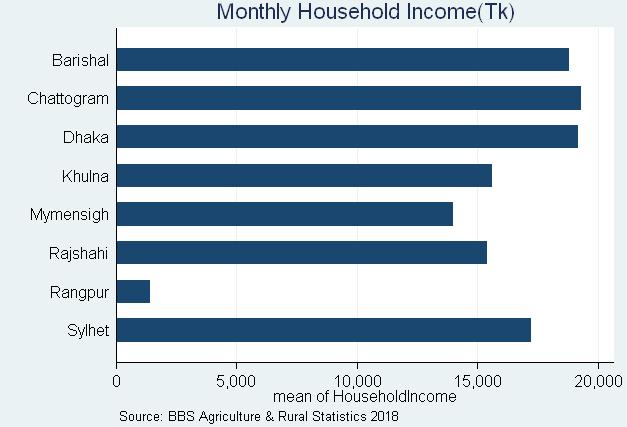
I recently come across “Report on Agricultural and Rural Statistics 2018(RARS 2018)”published by Bangladesh Bureau of Statistics(BBS). According to RARS 2018, agriculture accounts for 53.90 % of annual household income in Rangpur division, only division where agricultural sources dominate over non agricultural sources in determining the annual household income.In Dhaka, non agriculture constitutes 71.19% of annual household income. After Rangpur, agricultural activities are also reported to play a significant role in deciding annual household income in Mymensingh(47.98%), Khulna(46.99%) and Rajshahi (44.88%) divisions. Worst flood-hit districts like Niphamari, Lalmonirhat, Kurigram,Jamalpur, Sherpur and Netrokona lie in Rangpur and Mymensingh divisions. Taking a closer look at the monthly income reveals that monthly household income is lowest in Mymensingh (Tk 14009.83) divison, followed by Rangpur(Tk 14304.42) division. Meanwhile the highest monthly household income is registered in Chattogram(Tk19306.92), followed by Dhaka(Tk 19180.50).It is worthwhile to mention that in the informal sector of Dhaka, a Rickshaw puller and a construction helper draw a monthly salary between Tk 10,170 and Tk 11, 151 throughout the year.

Agricultural activity does not last throughout the year and non agricultural activity does not bring in everyone on board, so there is always the left outs. Wages without food for agricultural labor in all the divisions are pretty high. It somehow buttresses the claim that during the harvesting season even Tk 500/ day does not fetch a worker. However, working days per week are below 5.5 days in the rural areas. Please note that wages without food per day are Tk 360 in Rangpur division, Tk 355 in Rajshahi division and Tk 419 in Mymensigh division. Average working days per week are 4.95 days in Rangpur, 5.01 days in Rajshahi and 4.87 days in Mymensingh. Meanwhile a rickshaw puller gets on average wages of Tk 371 per day in all the working days in Dhaka. Consequently,, income gap and lack of opportunities during the post harvest season lead the rural workers to big cities like Dhaka. It is anticipated that this influx will be more severe in coming months unless well designed post flood relief efforts are taken in flood hit areas particularly in Rangpur and Mymensingh divisions.

Unnayan Onneshan, a not for profit organization, did a field survey among the slum dwellers engaged in informal sector in Agargaon and adjacent areas for a study titled “Accumulation And Alienation: State Of Labor Force in Bangladesh 2013”. In that survey, majority of the respondents (62.7%) said they took up jobs in informal sector due to job crisis in formal sector.

The RARS 2018 tells us that investment cost for transport vehicles and equipment is the highest in Rangpur division. RARS survey also reveals that NGOs appear to be major source of agricultural credit followed by banks. The recent flood without doubt compounded the debt problem of the farmers in the flood hit areas. Affected farmers deserve government’s assistance to attenuate their credit burden through cash benefits or access to interest free credit. The BBS survey highlights that both Aus and Aman crop registered post harvest losses of 8.93% and of 7.70% respectively out of total production in 2018. And the losses are mostly attributed to price volatility in the sales and to reasons associated with processing transportation and storage.

Clearly, pre flood post harvest losses have already pushed the farmers who are now poised to deal with post flood situation to a vulnerable position. Flood damages only augment their worries. In addition BBS rural data shows heavy reliance of rural households on rearing livestock and poultry. The reliance is heavy in flood hit divisions like Rangpur. It is evident that flood will cause significant damage to livestock and poultry. Media report suggests that in many areas cattle and cows are being sold at prices far below than the market prices , causing severe losses to livestock rearing families. Prices of feed and fodder may also go up in the post flood period if proper supply is not ensured.

In the wake of this severe Monsoon calamity, government strategies should focus on two tasks: 1. rejuvenate agricultural activities by providing agricultural credit at concessional rate and agricultural inputs at subsidized cost so that the farmers in flood hit areas can get back to the pre flood situation as soon as possible; 2. initiate programs in collaboration with NGOs to boost non agricultural income generating opportunities in flood hit areas so that rural workforce does not need to worry about lack of job opportunities and rural-urban migration flow does not turn worse.

Thursday, July 18, 2019

Regulate Rickshaws On Key Roads

Recently two city corporations made up their minds to curb free movement of rickshaws on Dhaka's key roads. Later Dhaka North City Corporation changed its position on restriction of rickshaws. Decision came on the wake of a day-long siege made by rickshaw pullers on key Badda-Pragati Sarani. Dhaka South City Corporation however has shown no sign to alter its position.

There is no gainsaying that there are too many rickshaws on the streets of Dhaka. And most of them are illegal.On many occasions rickshaw has been singled out for choking turning points and slowing down pace of the fast moving vehicles. Meanwhile , rickshaw has always been a source of livelihood for thousands of rural workers who throng to Dhaka everyday. According to Labor Force Survey 2017, informal sector employs 77% of urban labor force. And rickshaw pulling is one of the main informal sector professions. Back in 2014, I did a special story for an online news agency. Back then DMP imposed restriction on rickshaws on the key roads of Dhaka. Later this restriction was lifted and thousands of rickshaws inundated the streets of Dhaka, including the Manik Mia Avenue. As one industry insider revealed to me back in 2014, there were 6000 rickshaw garages and 225000 rickshaws in Dhaka and around 800000 men earned their breads by pulling rickshaw.The number might have risen significantly by now. What is interesting Dhaka City Corporation stopped issuing rickshaw license, the number is somewhere around 87,811, in the late 80s.In 2014, a valid license was sold at Tk 15000.Some owners' associations offered some kind of licenses to rickshaws. But these are not valid licenses and only good at finding a lost rickshaws in exchange of a small fee if it went missing. In 2014, a rickshaw puller has to pay Tk 100-120 for a full day shift and Tk 60-80 for half day. Right now a puller has to pay Tk80-100 for half a day. Bangladesh Institute Of Labor Studies recently conducted a study on Dhaka rickshaw pullers, titled " A Study Of Rickshaw Pullers Of Dhaka City" . In that study 58.4% of the rickshaw pullers say they took up rickshaw pulling as no other profession was available to them and it guarantees more income in less time. The study divulges that on average a rickshaw puller earns Tk 371.70 Tk per day and an average monthly income of Tk 11,151. It also finds that 91% of the pullers prefer the morning time to pull rickshaws. It is the busiest time of the day.
For my special story back in 2014,  I interviewed a rickshaw puller from Jaipurhat who told me agricultural workers of his district go back to their native villages in November and July. When they have no seasonal employment in villages, they come to Dhaka to drive rickshaws. Rickshaw numbers swell in festival seasons like Eid.

When we take a closer look at the Bangladesh Bureau of Statistics data on average daily wage of construction laborers in Dhaka, we will notice that average daily wage of a construction helper was Tk 414 in 2018. Meanwhile, in some selected industries ( cotton, jute, matches, engineering and edible oil) of  Dhaka , average daily wage for an unskilled worker was TK 339.6 and that for skilled worker was Tk 414.4 in 2018. So this guarantee of earning on average Tk 10,170/ month( as a helper) or TK 11,151/month (as a rickshaw puller ) is drawing more and more rural workers into Dhaka. I would like to add that wages in construction sector are not paid daily and a typical rural worker has to put more blood and sweat into construction work than into rickshaw pulling. Since a rural agricultural worker can make some quick bucks in less time and less effort, rickshaw pulling is becoming increasingly popular among this type of laborers.
The study conducted by BILS also reveals that 91% of the rickshaw pullers take foods and snacks from makeshift hotels and tea stalls during their working hours.Often these makeshift eateries generate steady stream of revenues for some quarter.

Despite the fact that rickshaw pullers are not subject of any extortion activity, they somehow indirectly contribute to the rent seeking economy built by a politically blessed quarter. For instance, accommodation is needed for this large pool of rickshaw pullers who spend months after months in this city. Part or full house and rickshaw rents they provide may go to the pockets of this vested quarter. Moreover cooked food they eat may be bought from the kitchen markets that offer regular extortion to a certain quarter. So part of their daily spending is feeding the labyrinth network of rent-seekers.

Despite strong arguments in favor of rickshaws of Dhaka, unintentional contribution of Dhaka rickshaw pullers to our extortion economy makes the case of unregulated rickshaw pulling untenable. It is pretty much agreed that it is time to put an end to unregulated rickshaws on key roads of Dhaka. Policy makers should step in to make sure easy and safe accommodation for rickshaw wallahs, to tab on their spending so that their money is not ended up in the pockets of rent seekers, to create a database of rickshaw pullers to keep check the rural-urban-rural migration flow and to initiate programs at rural and urban areas for improving their condition and creating more income generating opportunities.

Thursday, May 23, 2019

La Semaine Dernière A Mes Yeux


(17 mai --- 24 mai)

Selon un reportage, le gouvernement a caché le sondage sur la mortalité maternelle. L’étude a été faite par le ministère de la santé.  D’après le sondage, le taux de la mortalité maternelle a augmenté un peu en 2016, 196 par 100.000 personnes. En 2016, c’était 194. Les trouvailles ont été publiées dans le site de minisère. Mais elles ont été retirées quelques jours plus tard.

Selon une chronique, le gouvernement a aussi caché les trouvailles d’un sondage fait par Bangladesh Bureau of Statistics. Dáprès le sondage, le revenu a baissé par 2% et la consumption a baissé par 1 %.

Selon un reportage, Bangladesh Road Transport Authority s’est dit quíl y a 39 millions véhicules dont plus de 2,5 millions moto. Mais seulement 1,5 millions  conducteurs de moto possèdent le permis de conduire.

Selon un reportage, le ministère de l’intérieur a alerté tous les ambassades bangladais à l’étranger de ne pas donner permis de voyage aux djihadistes de Daech. Le plupart ne disposent pas de passeport. Donc, il se peut quíls puissent demander  permis de voyage à l’ambassade de Bangladesh pour retourner. Selon un autre reportage, 9 terroristes bangladais dont un recruteur se sont rendus à Kurdistan Counter Terrorism Group. 

Selon un reportage, 15 Bangladais secourus au large de Tunisie sont revenus au Bangladesh. Dans l'interview accordée à la presse , ils ont accusé les escrocs et l’agence de voyage,situé à Sylhet, pour la tragédie.

Selon un reportage, achat des meubles et oreiller, vaut Tk 1,46 billions, pour les appartements d'ouvrier de la centrale nucléaire à Rooppur a causé polémique dans tout le pays. Tsar de anticorruption Transparency International Bangladesh a mis en question cet achat.