Showing posts with label Bangladesh Economic Review 2018. Show all posts

Sunday, May 24, 2020

Devalue Currency To Augment Demand


Taka loses fast its value against dollar,
Reasons put forward for paying the bills of importer.
Increase in money supply depreciates local currency,
Devalued taka augments demand, output and local vacancy.
Overshooting exchange rate may approach stable value,
Lowering interest rate is a must amid pandemic flu.

A recent news report (May 20)says there has been a dollar crisis. To meet the growing import bill amid sluggish export, demand for dollar surged. Taka against dollar has been depreciated to Tk 88.50 at the banks. This is happening when government doled out Tk 5000 crore credit to RMG owners to clear dues of workers. In addition, government assured cash benefits to rural poor and other incentives to various sectors. By the time I am writing this piece, remittances in the month of Ramzan have reached $1.09 billion.

I embarked upon to see what impact an increase in M2 would leave on exchange rate. M2 comprises of currency outside bank, demand deposits, narrow money supply and time deposits. Data were taken from Bangladesh Economic Review 2018 for the period 1996-2018.

Autocorrelation check for 23 observations and 1 explanatory variable reported positive correlation (d = 0.374). I did not transform the data. It was assumed that during the unit root test inclusion of lagged residuals will take care the autocorrelation.

Then I went for unit root test to see whether exchange rate and M2 were stationary. To bare eyes, it appeared that both the variables wandered around a trend. So I constructed the following regression equations:

๐Ÿ”บ Excht = a + bt + c Excht-1 + d ๐Ÿ”บ Excht-1
๐Ÿ”บ M2t = a + bt + c M2t-1 + d ๐Ÿ”บ M2t-1
Where ๐Ÿ”บ Excht= Differences in exchange rate at t,
Excht-1 = exchange rate at t-1,
๐Ÿ”บ M2t= Differences in M2 at t,
M2t-1= M2 at t-1,
๐Ÿ”บ M2t-1= Differences in M2 at t-1,
t = a time trend variable, here year.

After the regression run , I obtained the following result: ๐Ÿ”บ Excht = -1778.34 + 0.902t -0.501Excht-1 + 0.455 ๐Ÿ”บ Excht-1
(t=-2.52, p=0.022, se=706.22) (t = 2.53, p=0.022, se=0.36) (t=-2.79, p=0.012, se=0.18) (t=1.97, p=0.065, se=0.230)
(F=3.39, p=0.042) ๐Ÿ”บ M2t = -7176664 + 3590.12t + 0.0028M2t-1 + 0.373 ๐Ÿ”บ M2t-1
(t= -2.59, p=0.019, se=2774933) (t=2.59, p=0.019, se=1386.81) ( t= 0.088, p= 0.93, se=0.0313) (t=1.27, p=0.22, se=0.29)
(F=67.54, p=0.00)

Huge standard errors put question mark on the intercept and trend coefficient of ๐Ÿ”บ M2 function. Tau statistics of slope coefficients of lagged exchange rate and M2 , -2.79 and 0.88 , in absolute terms were smaller than MacKinnon critical tau statistics at 5% level, -3.4620. So I did not throw away the null hypothesis that c=0 or exchange rate or M2 are nonstationary.

As the first differences of these two variables appeared to be nonstationary, it was assumed , for the sake of simplicity that they were integrated on order d,I(d). Regressing exchange rate on M2 , I obtained the residuals for cointegration test. Then I ran the following regression:

๐Ÿ”บ residt = b residt-1 + c ๐Ÿ”บ residt-1

And the result was: ๐Ÿ”บ residt = -0.160 residt-1 + 0.51 ๐Ÿ”บ residt-1

(t=-2.012, p=0.058,se=0.079) (t= 2.84, p=0.010,se=0.18)

(F=5.85,p=0.011)

The computed tau statistic -2.012 was greater than the critical value -3.37% at the 5% level of significance. I did not reject the null hypothesis that least squares residuals are not cointegrated. Cointegrated Regression Durbin Watson (CRDW) test also validated the claim . The computed d = 0.374 turned out to be smaller than the critical value 0.386 at 5% level of significance. So I did not reject the hypothesis that exchange rate and M2 are not cointegrated.

In this particular situation, exchange rate and M2 were I(d) series and not cointegrated. So I went for a VAR model:

๐Ÿ”บ Excht = b1๐Ÿ”บ Excht-1 + b2 ๐Ÿ”บ Excht-2+ b3๐Ÿ”บ M2t-1 + b4 ๐Ÿ”บ M2t-2+ v๐Ÿ”บExcht

๐Ÿ”บ M2t = c1 ๐Ÿ”บExcht-1 + c2 ๐Ÿ”บ Excht-2+ c3 ๐Ÿ”บ M2t-1 + c4 ๐Ÿ”บ M2t-2+ v๐Ÿ”บM2t

VAR model did not fit well (๐Ÿ”บ Exch chi2 =6.88, p= 0.144, and for ๐Ÿ”บ M2 chi2= 142.85, p=0.00). Nevertheless, I wanted to see the Impulse Response Function (IRF) that shows effect of a shock of endogenous variable on itself and other endogenous variables. An increase in orthogonalized shock to M2 resulted in a short decrease ( depreciation of Taka ) in the exchange rate that withers away 1 period later.

Though the VAR model is to be accepted with a dollop of salt, this is pretty much in line with theory found in economic text book. Temporary drop in global demand shifts the DD schedule, which shows mixes of output and exchange rate for keeping output market in equilibrium in the short-spell, to the left. This in turn reduces full employment-level output to a lesser level, provoking depreciation of currency. A currency depreciation augments both aggregate demand and output at home. Meanwhile, increase in money supply in the domestic market depreciates exchange rate and causes AA schedule, which links exchange rates and output levels to keep the money and foreign exchange markets in equilibrium, to shift upward. Domestic goods become more competitive in global market , triggering a rise in domestic output and employment. For a given level of output, an increase in money supply can cause exchange rate to overshoot its long-term exchange rate for a while. One may argue that since our import surpasses our export and in this time of falling export earnings a depreciation may erode our current account balance. Point is that economic theory says for a brief period there may be a dent in the current account balance (ours a negative) but in the long run it will definitely improve.

Point is currency depreciation is good for our economy and wild fall in Taka may approach its long-run value with the course of time. To revive the falling demand, government can do more apart from doling out incentives. One step can be to lower the domestic interest rate in a bid to increase the money supply.

Monday, April 13, 2020

A Hedge Against Uncertainty In Agribusiness


Corona robs joy of poultry farmer,
Eggs are sold far below market can offer.
Time has come to introduce big buyer,
Way of hedging against loss & not letting him suffer.
Coronavirus stretched its shadow over poultry farming, dairy farming and other agribusinesses. News reports say gloomy dairy farmers are selling their milk much below the market price. Mobile egg sellers are selling eggs at Tk 75/dozen. In normal times, a dozen would cost Tk 120. Evidently, poultry farmers and dairy farmers bear the full brunt of the falling demand, compounded by indefinite lockdown.

Poultry and dairy farming are 100% value adding economic activities. Money was often drawn from local cooperatives, relatives, microfinance institutions and even public banks. Any bad spell to farming activities will augur ill for informal and institutional investors. So in a broader sense, many investors’ money may be lost if poultry and dairy projects fail because of Coronavirus.

If poultry farmers and dairy farmers are not duly compensated for the loss, then we may see a production slump in the subsequent years, adding further woes to the consumers by raising the prices of eggs and milk. Egg is the cheapest source of protein. Any supply shock or price hike in fish or meat leads to consume more eggs. As it appears, this Coronavirus may also make a dent in our protein consumption.

I did a little analysis on the impact of disaster years on egg price for the period 2012-2018. For the given period I gathered data for fish(Rui) and egg prices. Data gleaned from BBS Statistical Pocket Book 2016 and 2018.

At 5% level of significance and for 7 observations and 1 explanatory variable, the Durbin-Watson statistic reported no autocorrelation(d = 2.345).

It was assumed that for ordinary citizens fish and egg secured the bottom places in the protein ladder in terms of price. So, apart from supply and demand side factors egg price to some extent depends on fish price. It was also assumed that eggs were sold at Tk 95 per dozen in 2017 as the data for that year was not available.

Following regression function was constructed:

lnEggt = a + b Fisht + c Dt
where lnEggt = log natural of Egg price at t,
Fisht = Fish price at t,
D = 1 for disaster years ( any kind) ,
= 0 form calm/ normal years.

After running the regression got the following result:

lnEggt = 4.97 -0.0012 Fisht + 0.00616 Dt (F= 1.153, p = 0.402)
(t=18.64, p= 0.000048) (t= -1.48, p= 0.211) (t= 0.117, p=0.91)

Except the intercept, neither the model nor the slope coefficients turned out to be significant. If the coefficient of the dummy variable were significant, we would say that egg prices during disaster years were 0.62% higher than those during calm years.

For the current year, we are witnessing that egg price hits all time low in the last 10 years. Unfortunately, our market conspicuously lacks mechanism of hedging against volatility. Moreover, in a corrupt country like ours compensation for disasters may often fall in wrong hands, mocking the steps to aid victims. As it is noticed, borrowers of microcredit often receive compensation during bad times due to their attachment to institutional lenders. By the same token, if we develop some kind of institution in farming and agribusiness model, then we will ensure just prices for our farmers and will insulate them from any volatility from man-made or natural disruption.

Game theory helps us better to grasp this point. Here I present a sequential game. Pairs of numbers in the game tree represent payoffs to poultry farmer(P) and wholesaler(W). Poultry farmer has two choices to make: to make a contract with an institutional distributor to sell his eggs at negotiated price in the future(C); or not to make the contract with big distributor and rely on the usual middlemen(NC). Meanwhile, for wholesaler, the choice is to offer the prices of normal market(N) or the volatile market (V)reading the market demand.

The first number in the pair represents the price received by the poultry farmer by selling a dozen of egg. The second number represents the payoff to wholesaler by selling a dozen of egg.

Two important criteria for determining the outcome of the game are:

⚫ Provided that what the others have chosen, a player’s decisions must be optimal.
⚫ At the time decisions are taken, they are optimal for the decision-maker.

Looking at game tree, we realize that for two subgames there are two Nash equilibria. If poultry farmer chooses no contract with big distributor, then wholesaler’s optimal decision will be to offer the normal market price. (96,120) is the equilibrium here. Because Tk 120 is greater than Tk 75 for the wholesaler. If the poultry farmer goes for contract with big distributor then wholesaler’s response will be to go for normal market price offer. Here the Nash equilibrium is (108,140).

For poultry farmer, a decision at the present time depends on his returns in the future. He will compare his returns under two states. He will notice that a contract will fetch him Tk 108 and no-contract will get him Tk96. Moreover, volatile prices (Tk 48 > Tk 36) are higher under contract. Since Tk 108 under contract-normal market price is higher than Tk 96 under no-contract –normal market price, his optimal decision will be Tk 108. So poultry farmer looks forward but reasons backward. When poultry farmer chooses the contract, wholesaler will go for the normal-market price, Tk 140 here. So (108,140) is the subgame perfect equilibrium here.

Underlying assumptions here in this discussion are---- there are many big distributors (including the govt backed-one) apart from middlemen; returns under contract with distributors are higher than those under no-contract. Moreover, in any kind of disaster like situation if the govt wants to send compensation then it can do so through the distributors.

Anyone could become this big distributor. Egg cooperatives, TCB, a public listed company or a big local group could easily vie for a big distributor. Govt has to ensure that there are many of these distributors and they operate under certain laws.

Key take-away of this discussion is : big distributors are needed in agribusiness to protect the farmers from volatility and uncertainty. Their presence will ensure just prices for the farmers as well as help flawless distribution of compensation in a disaster like situation.

The idea of big distributors should be preceded by new laws or fine-tuning of existing ones. Laws demarcate do’s and don’ts for the parties in crisis like situation and dispel any ambiguity. Value-adding nature of agribusiness and involvement of informal investors calls for greater govt protection. Laws should be attuned to these ground realities.

Tuesday, March 31, 2020

Corona And Debt Service Payment


Corona casts shadow over export earning,
It starts alarm bell ringing
Over debt service payment.
Disaster means weak debt management,
Reflected in lower annual installment.
Platform of Bangladesh’s garments exporters, BGMEA, confirmed that $2.87 billion worth of export order cancelled before March 30. Evidently, Coronavirus outbreak unleashes its harming effect on economy. Unarguably, this pandemic may affect more or less all the forex earning sources. Less pledges of foreign assistance are made for the ongoing fiscal year. There is little room for optimism for coming fiscal year. As it appears, our Debt Service Payments may also take a hit because of pandemic crisis.

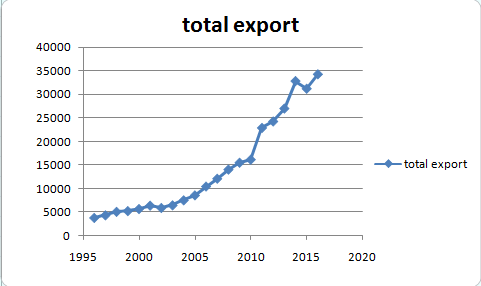
I did a little analysis on debt service payments and total export based on 20-year-long data from 1996 to 2016. Debt Service Payments largely depend on forex earnings. Export is one of the key sources of forex earnings. What kind of influence export has on debt service was what I would like to see. Data gleaned from Bangladesh Economic Review.

As usual, I first went for autocorrelation check. Durbin-Watson statistic was found to be 1.46 for 21 observations and 1 explanatory variable. So there was no autocorrelation. It reported positive autocorrelation


(Source:Bangladesh Economic Review 2018)
Then I went for stationarity check. Visual inspection of both debt service and export series insinuated that they wandered around a trend. So I constructed following regressions:

๐Ÿ”บ Debtt = a + b Debtt-1 + ct
๐Ÿ”บ Exportt = a + b Exportt-1 + ct
Where ๐Ÿ”บ Debtt= Differences in debt services at t,
Debtt-1 = Debt service payments at t-1,
๐Ÿ”บ Export t= Differences in export earnings at t,
Exportt-1= export earnings at t-1,
t = a time trend variable, here year.

Tau statistics of slope coefficients of lagged Debt and Export, -2.435 & -1.248 , in absolute terms were smaller than MacKinnon critical tau statistic at 10% level, -2.584. So I did not reject the null hypothesis that b=0 or Debt and Export show an unit root or they are nonstationary.

To my dismay first differences of Debt and Export did not turn out to be stationary. So both Debt and Export, for the sake of simplicity, were integrated of order d, I(d).

Regressing Debt on Export I got the residuals for cointegration test. Then I ran the following regression:

๐Ÿ”บ Residt = b Residt-1 + c ๐Ÿ”บ Residt-1

The computed tau statistic of lagged residual's slope coefficient, -3.94, was greater than Engle-Granger critical statistic at 5% level in absolute terms, -1.94. So I rejected the null hypothesis of no cointegration or residuals are nonstationary. There was indeed a cointegrating relationship between the two and residuals appeared to be stationary.

This kind of situation, variable were I(d) series and cointegrated, requires a VEC model :

๐Ÿ”บ Debtt = p + q Residt-1+ vtDebt

๐Ÿ”บ Exportt = r + s Residt-1+ vtExport

where Residt-1= lagged residuals obtained from regressing Debt on Export Resulting model looked like this:

๐Ÿ”บ Debtt = 33.083 -0.508 Residt-1(F=2.19, p=0.155)

(t=1.84, p=0.08) (t=-1.48, p=0.155)

๐Ÿ”บ Exportt = 1483.07 + 4.47 Residt-1(F=0.276, p=0.605)

(t=3.334, p=0.033) (t=.525, p=0.605)/>

None of the individual functions and slope coefficients appeared to be significant. However I was eager to see impact of a shock to Export on Debt Service Payments. As usual I depended on Impulse Response Function(IRF), which shows the effect of a shock to an endogenous variable on itself and on other endogenous variables.

An orthogonalized shock to Export revealed that it had permanent effect on Debt Service and it did not die out over time.

Later I turned to see whether disaster years, be it natural or political or international, had any effect on debt service payments. I constructed the following regression function:

lnDebtt = a1 + b Export t+ a2Dt

where lnDebtt = log natural of debt service payments at t,
Export t = export earnings at t
D = 1 for disaster years,
= 0 for normal years.

This model turned out to be significant (F= 90.15, p = 0.00, degree of freedom = 2, 18) Resulting resulting regression function looked like this:

lnDebtt = 6.20 + 0.000028 Export t- 0.0657Dt

The dummy coefficient , however, appeared to be insignificant (t = - 1.50, p = 0.15). Had it been significant, it would be said that debt service payments in disaster years were 6.36% lower than those in normal or calm years.

More or less it is becoming clear that Coronavirus may affect our debt service payments by harming our forex earning sources. Any drop in debt service payments in disaster years may put pressure on subsequent years. As external assistance pledges are not on the surface, government may go for costly options for foreign borrowing coupled with significant scrapping of development projects at home.

Thursday, January 23, 2020

Shahana Leads The Way


Sycophants, party men and crony
Feast on government money.
There is no short of excuses:
Fight poverty, education, woman empowerment.
Corruption has reached all departments.
Still stalkers on prowl,
Violence grips the soul.
Then there is the light,
Kids show how to fight.
They make cartoon for the class,
'Shahana' will build a new kind of mass.
A small initiative draws my attention. "Shahana"--- a cartoon series made by a group of school goers in a bid to stop discrimination, to build awareness  and to reduce incidence of violence against women --- is finally being shown in classrooms. Educational content, taking full advantage of visual media, is employed to combat social maladies. Luckily this initiative got the much needed government support , which most private initiatives often failed to gather. Screening of this cartoon series comes at a time when the society descended into a collapse of  law and order. Harrowing act of violence is purported on women everyday.

Despite support and spendings by government, things have improved little over a decade. I took a look at government allocation on some selected social sectors over the last one decade. These allocations are meant to develop human resources. Allocations under consideration went to ministry of ICT & education, ministry of social welfare, ministry of labor, ministry of sports,ministry of health and family welfare and ministry of CHT. Data on allocation to some selected social sectors are readily available in Bangladesh Economic Review. Except one or two ministries, all the ministries undertake programs that develop human resources and create awareness on violence against women.

For instance, one of the ministries, ministry of education and ICT, saw an allocation bulge in the last one decade. But did  government spending make a difference at the ground? Did they really achieve their intended goals? I try to probe the matter. In this regard, I gleaned data on victims of violence against women.

Odhikar put up data of violence against women on its website regularly. Rape victims and dowry victims are defined here victims of violence against women. So here victims represent these two categories of victims. I am interested to see how the number of victims changes in relation to allocations on key social sectors between 2004 and 2017. I split the data in two periods: 2004-2008, dubbed as pre 2009 election period and 2009-2017 , called here as post 2009 election period. Changes in number of victims in relation to allocation for 2009-2017 seem to differ from 2004-2008. It suggests a structural change. More precisely, a structural change may indicate two intercepts are different, or two slopes are different, or both the slope and intercept are different or any other combination of parameters. Meanwhile, no structural change means structural stability. I am keen where to probe whether the victim function has experienced any structural change in the two periods, meaning whether parameters of the function have changed.

With the help of dummy variable I constructed the following regression:

Victimsi = a1 + a2Di+b1Ai+ b2(DiAi)+ui

Where Victimsi are victims of violence against women, Ai is allocation to selected social sectors, Di=0 for period 2004-2008 and Di= 1 for period 2009-2017.a2is the differential intercept and b2 is the differential slope coefficient.

For the observations of the given period, I find that stability of the entire regression, no structural change, (a2=b2=0) is accepted by the usual F test(F=1.805, p= 0.2098, df= 3,10). Moreover, on individual inspection, the a2(t=-1.759, p= 0.108) and b2(t= 2.13, p= 0.059) are found to be statistically insignificant. So from the given data  the test indicated that no structural change has taken place between two period.

The observations however did not include the victims' stat of 2018 and 2019. In the last two years, there has been a bulge in the number of victims of violence against women. This has happened while the allocations to selected social sectors have increased. And the statistical analysis just discussed little while ago shows variations of changes in victims' number are one same slope coefficient that prevailed in the period before 2009 election. So none with confidence can say increased allocations to selected social sectors led to bigger decline in the number of victims in recent years. For any given increase in allocations, there were no big decline in the number of victims.

Bigger allocations often do not translate into lesser number of victims.  No one with confidence can say that government spending played a role in developing human resources and awareness building on violence against women. A quick look at the stat reveals that in 2006 total allocations were Tk 15725 crore and number of victims was 1008. In 2017,  allocations were Tk 82324 crore and number of victims was 1045. Clearly there is something wrong the way government spends its money. It is spending so much but gaining so little.

A much prudent step would be to give support to private initiative like "Shahana". Public-private partnership could pave the path for combatting violence against women.
Targeting the adolescents and school goers, as " Shahana" did, could be an effective way to deal with the menace of violence against women. Government can reach out bloggers, content makers and other professionals to inculcate adolescents with a respect for women, their rights. At the same time, government can lend support to private initiative on sex education via social media so that adolescents know about it and dispel any ambiguities about this topic that deems taboo in our society.

This private initiative will not swallow huge money like government allocation. It only needs government support and patronage. Riding the tide of social media age, government with right attitude can undertake projects to connect public and private sectors in order to ensure gender equality and violence free society.

Friday, December 27, 2019

Time To Look For Alternate Overseas Job Market

External job market for Bangladeshi workers does not look that good. Traditional market like Saudi Arabia remained stagnant. Only conditional recruitment is going on there after it remained closed for Bangladeshis for sometime: Bangladeshi female domestic worker should be sent to resume recruitment of Bangladeshis.

Meanwhile, Malaysia, another major destination for Bangladeshi workers, has launched an amnesty program for illegal immigrants. "Back for Good" program, launched in August 1 and will expire by December 31, aims to curb significantly illegal foreign workers who have overstayed their visas by sending them back to their country of origin after paying a punitive fine. One year later they will be eligible for re-recruitment. News report hints that around 30000 undocumented Bangladeshi workers will face full brunt of B4G program. Situation is so dire that national flag carrier, Biman Bangladesh Airlines, has increased frequencies of flights between Kuala Lumpur and Dhaka to meet the deadline so that stranded Bangladeshi workers do not face severe punishments.

Falling remittances flow from traditional sources and adverse policies in some markets cue new efforts to search alternative markets. There are some destinations  that look promising but series of bad incidents overshadow the good prospect.

Series of killing by gunshots imperil the very existence of Bangladeshis in South Africa, where they successfully started grocery and other small businesses. In the  last five years, around 400 Bangladeshis were gunned down. News reports indicate that South Africa too is a popular destination for undocumented Bangladeshi workers. Having worked for two or three years, many managed to grab legal documents. Even these undocumented workers are not insulated from ghastly gun violence.

Earlier, law-enforcement agencies back home arrested cohorts of abductors resided in Libya for abducting Libya-bound illegal Bangladeshis and asking for ransoms to relatives back home.

In Saudi Arabia, tortures meted out to female domestic help of Bangladeshi origin turned Bangladeshis' stomach. Reuters carried a report that claimed that there was an online site for selling poorer women, hailing from third world countries, to Middle Eastern clients. In that nomadic culture housemaid does not enjoy a respectable life.  Once a migrant worker told me that God made "halal" till knee part of a washerwoman's body. I don't know how much truth it contained but I was shell shocked. Even I find the French word, "femme de chambre" or "bedroom woman",  for a domestic help shocking. The French colonized a large part of sub Saharan Africa and part of Middle East. Maybe the word has its roots from that part of the world. Look at the final resting places of the Pharaohs whose decorated secret chambers also contained mummies of slaves. The film "Charlie Wilson's War" offers another account of sporting spectacles of slave girl trade.

In the movie, a congressman throws party for elites and stages a funny slave girl trade. These social elites get along well with their Middle Eastern partners. Perhaps the auction is intended to entertain the guests. Since vestiges of nomadic culture is still prevalent in those societies, we should take precautionary steps while sending housemaid there.

Back in last week of November, around 35 female workers took refuge in a repatriation center in Saudi Arabia, fleeing violence at workplace. Luckily, frequency of such horrifying incidents precipitated the Saudis to launch a special service to take calls from housemaid in distress.

Bangladeshi government needs to do more: recruiting more Bangladeshi staff who speaks dialects of workers at the embassy in Riyad, signing more complementary agreements  with the Saudis to ensure safety of these workers and stalling the recruitment for sometime if necessary.

 In Karnataka ,India, a drive against Bangladeshi domestic help was launched couple of months ago. Karnataka government alerted the apartment owners and advised them to discharge their domestic help as soon as possible. It appeared that Bengali domestic helps cook very well and very docile so Bengali middle class there prefers recruiting them. Language barrier does not appear to be a major problem in communicating like Saudi Arabia.Somehow the xenophobia that evil quarter may misuse the poor workers led to this anti-Bangladeshi drive in the region.
Given the dismal picture in existing overseas employment markets , searching new one as well as more efforts of engagement with the existing markets are called for.

If we take a close look at the remittances for the last 10 years we will see that remittances from Saudi Arabia and UAE declined for the last five years. Meanwhile, remittances from USA,UK and Malaysia increased significantly for the last ten years.
Since we inclined heavily towards sending semi-skilled and unskilled workers, it is better to devise new ways so that we could send more workers to new overseas markets and induce others to take more workers from us.
Bangladesh could lobby other traditional markets to replicate the Malaysian "B4G" program. Under the program, workers in rotation will go abroad and come back to home for a predetermined period. Government initiatives can assure the participating workers that government will take care of their housing and healthcare needs if they comply with the rules of the program. Government can also build subsidized housing unit for this target group of workers.

Bangladesh could also sign special agreements with India to send domestic help, construction worker and agricultural laborer. If any major Indian city does not have reservation from hiring Bangladeshi domestic help, then under government-to-government contract special work permit can be awarded to this kind of workers. Local Indian High Commission can ensure smooth distribution of the permits and can make sure that remittances sent by these emigrant Bangladeshi workers may end up in right hands and may use in home renovation, providing good education to children and providing good medicare.

There are many humanitarian NGOs in India. They work for vulnerable groups and operate many safe houses. Unlike Middle Eastern countries, Bangladeshi domestic help will enjoy safe and secure life there as the population in general is not hostile towards them.
In exchange, Bangladesh can issue more professional visas to Indians, hailing from those Indian States that welcome Bangladeshi workers, to work on RMG, textiles and IT sectors. It will help tremendously to balance the remittance flows between the countries.
Iran and countries belong to former Soviet Union could also be viewed as potential destinations of overseas employment. Unfortunately,Bangladesh never explore the Iranian construction, agriculture and shipbuilding industries where Bangladeshi workers could make valuable contribution.US sanctions could cause some trouble as Iranian central bank also falls under the new sanction, but Bangladesh could join multilateral initiatives to bypass them.

African countries could be destinations for setting up small businesses and agricultural farms. Bangladesh could ink deals with South Africa and Libya to provide law enforcement assistance in those countries in a bid to reduce the incidence of gun violence and human trafficking. If Bangladeshi financial institutions are allowed to operate in these countries, then small businessmen could get easy credit to start businesses.


Tragic tales of our migrant workers in Saudi Arabia , South Africa and Libya insinuate that overseas employment industry is infested with thugs and they act here without facing any obstacle and remorse. While innocent souls perished abroad, reputation of the country took a bad hit. Undeniably foreign hands also took part in this kind of criminal act. Unfortunately, from our part, we have not yet taken any step to identify the culprits and to bring them to book. Nonchalance stance hampers the traditional markets and puts obstacles to finding new ones for our workers. Unless we address the issues at home, chances are slim that things will be better for our overseas employment situation.