Showing posts with label Corona Virus. Show all posts

Monday, April 13, 2020

A Hedge Against Uncertainty In Agribusiness


Corona robs joy of poultry farmer,
Eggs are sold far below market can offer.
Time has come to introduce big buyer,
Way of hedging against loss & not letting him suffer.
Coronavirus stretched its shadow over poultry farming, dairy farming and other agribusinesses. News reports say gloomy dairy farmers are selling their milk much below the market price. Mobile egg sellers are selling eggs at Tk 75/dozen. In normal times, a dozen would cost Tk 120. Evidently, poultry farmers and dairy farmers bear the full brunt of the falling demand, compounded by indefinite lockdown.

Poultry and dairy farming are 100% value adding economic activities. Money was often drawn from local cooperatives, relatives, microfinance institutions and even public banks. Any bad spell to farming activities will augur ill for informal and institutional investors. So in a broader sense, many investors’ money may be lost if poultry and dairy projects fail because of Coronavirus.

If poultry farmers and dairy farmers are not duly compensated for the loss, then we may see a production slump in the subsequent years, adding further woes to the consumers by raising the prices of eggs and milk. Egg is the cheapest source of protein. Any supply shock or price hike in fish or meat leads to consume more eggs. As it appears, this Coronavirus may also make a dent in our protein consumption.

I did a little analysis on the impact of disaster years on egg price for the period 2012-2018. For the given period I gathered data for fish(Rui) and egg prices. Data gleaned from BBS Statistical Pocket Book 2016 and 2018.

At 5% level of significance and for 7 observations and 1 explanatory variable, the Durbin-Watson statistic reported no autocorrelation(d = 2.345).

It was assumed that for ordinary citizens fish and egg secured the bottom places in the protein ladder in terms of price. So, apart from supply and demand side factors egg price to some extent depends on fish price. It was also assumed that eggs were sold at Tk 95 per dozen in 2017 as the data for that year was not available.

Following regression function was constructed:

lnEggt = a + b Fisht + c Dt
where lnEggt = log natural of Egg price at t,
Fisht = Fish price at t,
D = 1 for disaster years ( any kind) ,
= 0 form calm/ normal years.

After running the regression got the following result:

lnEggt = 4.97 -0.0012 Fisht + 0.00616 Dt (F= 1.153, p = 0.402)
(t=18.64, p= 0.000048) (t= -1.48, p= 0.211) (t= 0.117, p=0.91)

Except the intercept, neither the model nor the slope coefficients turned out to be significant. If the coefficient of the dummy variable were significant, we would say that egg prices during disaster years were 0.62% higher than those during calm years.

For the current year, we are witnessing that egg price hits all time low in the last 10 years. Unfortunately, our market conspicuously lacks mechanism of hedging against volatility. Moreover, in a corrupt country like ours compensation for disasters may often fall in wrong hands, mocking the steps to aid victims. As it is noticed, borrowers of microcredit often receive compensation during bad times due to their attachment to institutional lenders. By the same token, if we develop some kind of institution in farming and agribusiness model, then we will ensure just prices for our farmers and will insulate them from any volatility from man-made or natural disruption.

Game theory helps us better to grasp this point. Here I present a sequential game. Pairs of numbers in the game tree represent payoffs to poultry farmer(P) and wholesaler(W). Poultry farmer has two choices to make: to make a contract with an institutional distributor to sell his eggs at negotiated price in the future(C); or not to make the contract with big distributor and rely on the usual middlemen(NC). Meanwhile, for wholesaler, the choice is to offer the prices of normal market(N) or the volatile market (V)reading the market demand.

The first number in the pair represents the price received by the poultry farmer by selling a dozen of egg. The second number represents the payoff to wholesaler by selling a dozen of egg.

Two important criteria for determining the outcome of the game are:

⚫ Provided that what the others have chosen, a player’s decisions must be optimal.
⚫ At the time decisions are taken, they are optimal for the decision-maker.

Looking at game tree, we realize that for two subgames there are two Nash equilibria. If poultry farmer chooses no contract with big distributor, then wholesaler’s optimal decision will be to offer the normal market price. (96,120) is the equilibrium here. Because Tk 120 is greater than Tk 75 for the wholesaler. If the poultry farmer goes for contract with big distributor then wholesaler’s response will be to go for normal market price offer. Here the Nash equilibrium is (108,140).

For poultry farmer, a decision at the present time depends on his returns in the future. He will compare his returns under two states. He will notice that a contract will fetch him Tk 108 and no-contract will get him Tk96. Moreover, volatile prices (Tk 48 > Tk 36) are higher under contract. Since Tk 108 under contract-normal market price is higher than Tk 96 under no-contract –normal market price, his optimal decision will be Tk 108. So poultry farmer looks forward but reasons backward. When poultry farmer chooses the contract, wholesaler will go for the normal-market price, Tk 140 here. So (108,140) is the subgame perfect equilibrium here.

Underlying assumptions here in this discussion are---- there are many big distributors (including the govt backed-one) apart from middlemen; returns under contract with distributors are higher than those under no-contract. Moreover, in any kind of disaster like situation if the govt wants to send compensation then it can do so through the distributors.

Anyone could become this big distributor. Egg cooperatives, TCB, a public listed company or a big local group could easily vie for a big distributor. Govt has to ensure that there are many of these distributors and they operate under certain laws.

Key take-away of this discussion is : big distributors are needed in agribusiness to protect the farmers from volatility and uncertainty. Their presence will ensure just prices for the farmers as well as help flawless distribution of compensation in a disaster like situation.

The idea of big distributors should be preceded by new laws or fine-tuning of existing ones. Laws demarcate do’s and don’ts for the parties in crisis like situation and dispel any ambiguity. Value-adding nature of agribusiness and involvement of informal investors calls for greater govt protection. Laws should be attuned to these ground realities.

Sunday, April 5, 2020

Trust The Micro Lenders


Govt backed Social security program ,
Seldom reach village & slum.
Micro lenders doing great job,
Helping borrowers hit by disaster.
Setting shining example in the globe.
Yet calamity hobbles their operation,
Hampering the process of resource creation.
There is little doubt that Coronavirus will leave an anemic economy. There has ,however, been little plans afoot to bring life to vital sectors of the economy with the help of others. Government initiated some local level social security programs without bringing aboard the non governmental organizations. Government-backed social security programs seldom trickle down to target group of people, a view pretty popular among ordinary citizens.

There may be some truth in it. Back in November and December last year, I interviewed 40 rickshaw pullers to grasp well spending and savings behavior of Dhaka rickshaw pullers. When I asked them whether they received any social security benefits from the government, I got three affirmative responses. One got rice from vulnerable group feeding program, another's father received old age benefit and one rickshaw puller's wife got lactating mother's benefit. All three had closer ties with local government representatives: one's relative was union parishod member, the other two had links with ruling elites. So three out of forty rickshaw pullers received government sponsored social security benefits. The forty-respondent strong study may not representative but is an indication how ineffective the government social security program is.

Meanwhile, micro-lending institutions are far more helpful in post disaster periods. In that study, one rickshaw puller, hailing from Borishal, told me one leading microcredit institution gave him, an existing borrower, a calf to recuperate the loss he sustained in Sidr. It is also important to note that a huge section of beneficiaries are women and bottom rung of the society, who generate resources in the economy by raising livestock and sharecropping.

Despite a sustained effort to cast aspersions on microcredit institutions, they are doing a commendable job to scale up the have-nots and accelerate the economy. However, disasters also hobble their operations and seriously harm empowerment of the poor. Microcredit institutions are vital to provide any economic support to the marginalized and vulnerable population.

Recently, I embarked upon to look at disaster year's influence on microcredit operations of three leading microcredit institutions. Data for the period 2005-2018 gathered from Bangladesh Economic Review. Disaster years were political or international or natural disasters that hurt the economy.

Durbin-Watson statistic for ASA and Grameen reported no autocorrelation. For 14 observations and 1 explanatory variable, ASA had a statistic d= 1.695 and Grameen's statistic was d = 1.716. However, for BRAC, it fell into indecisive zone (d = 1.048). Modified d test was found to have positive autocorrelation (d= 1.084< du= 1.35).

For ASA and Grameen , following regression functions were constructed:

lnDisbt = b1 + b2Rect + b3Dt

Where lnDisbt = log natural of disbursement at t,
Rect = Recovery at t,

D= 1 for disaster years,
= 0 for calm years.
And for BRAC, following regression function was chosen:

Disbt = a + b Dt + c Rect + d Dt Rect
+ ut


where Disbt = Disbursement at t,
Rect = Recovery at t,
D= 1 for disaster years,
= 0 for calm years.
and ut was generated through AR(1) scheme:

ut = ut-1 + e

Since BRAC data had positive correlation, transformed function was constructed. From known P, I derived (Disbt - PDisbt-1) as regressand and (Rect - PRect-1) as regressor. This approach was resulted in loss of 1 observation for both. Prais-Winsten transformation (√1-P2 Disbt and √1-P2 Rect ) was done to prevent it. For calm years, values of D were zero. But first observation of disaster years was set 1/(1-P) and 1 for the rest of the disaster years. Dt Rect
was zero for the calm years. First observation for disaster years was assigned Dt Rect
= Rect and all observations were assigned (Dt Rect - Dt Rect-1) = ( Rect - P Rect-1)
The resulting functions appeared to be:

ASA: lnDisbt = 8.99 + 0.0000067Rect - 0.144Dt (F= 2.588, p= 0.12) (t=35.70, p=0) (t=2.27, p= 0.043) (t= -0.42, p= 0.67)
Grameen: lnDisbt = 9.083 + 0.00012Rect - 0.0038Dt (F= 67.85, p= 0.0)
(t=73.07, p=0) (t=11.53, p= 0.00) (t= -0.038, p= 0.96)
BRAC: Disbt = -0.506 - 37.214 Dt + 1.112 Rect + 0.0037 Dt Rect (F= 506.9, p= 0)
(t= -0.001, p= 0.99) (t=-0.125, p=902) (t=18.63, p=0.00) (t=0.061, p=0.95)

The model fit well for BRAC. However, differential intercept and differential slope coefficients were found to be insignificant. Had the differential intercept coefficient been significant, we would say that BRAC's disbursement of microcredit during disaster years was lower by Tk 37.214 crores.

Regression model for Grameen fit well at 5% level of significance, as reported by F. Meanwhile, it did not fit well for ASA at that level of significance. However, slope coefficient for dummy variable for both the model did not appear to be significant. Had it been significant, we would say Grameen's disbursement for disaster years was 0.38% lower than that of normal years and ASA's disbursement for disruptive years was 13.45% lower than that of normal years.

It is evident that disruption resulting from various forms of disasters has harming effect on microcredit operations. This may affect economic activities of have-not communities.

Since microcredit institutions scattered all across country and they have a large borrowers' base, post disaster efforts will be better implemented with their help. Misappropriation will be lower if the fund is distributed through them. At the same time, more government money should be injected into microcredit institutions so that microcredit operations, or economic activities of the have-nots, do not get affected by Coronavirus. Money at the hands of Have -nots and marginalized groups means resource creation, leading to increase of GDP. And microcredit institutions are leading the way in terms of resource creation.

Tuesday, March 31, 2020

Corona And Debt Service Payment


Corona casts shadow over export earning,
It starts alarm bell ringing
Over debt service payment.
Disaster means weak debt management,
Reflected in lower annual installment.
Platform of Bangladesh’s garments exporters, BGMEA, confirmed that $2.87 billion worth of export order cancelled before March 30. Evidently, Coronavirus outbreak unleashes its harming effect on economy. Unarguably, this pandemic may affect more or less all the forex earning sources. Less pledges of foreign assistance are made for the ongoing fiscal year. There is little room for optimism for coming fiscal year. As it appears, our Debt Service Payments may also take a hit because of pandemic crisis.

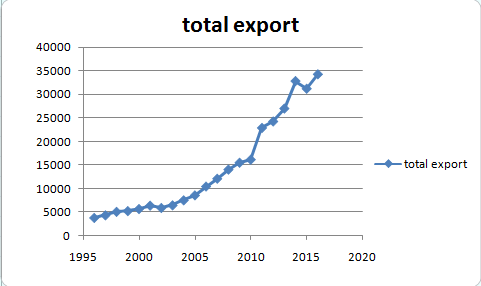
I did a little analysis on debt service payments and total export based on 20-year-long data from 1996 to 2016. Debt Service Payments largely depend on forex earnings. Export is one of the key sources of forex earnings. What kind of influence export has on debt service was what I would like to see. Data gleaned from Bangladesh Economic Review.

As usual, I first went for autocorrelation check. Durbin-Watson statistic was found to be 1.46 for 21 observations and 1 explanatory variable. So there was no autocorrelation. It reported positive autocorrelation


(Source:Bangladesh Economic Review 2018)
Then I went for stationarity check. Visual inspection of both debt service and export series insinuated that they wandered around a trend. So I constructed following regressions:

🔺 Debtt = a + b Debtt-1 + ct
🔺 Exportt = a + b Exportt-1 + ct
Where 🔺 Debtt= Differences in debt services at t,
Debtt-1 = Debt service payments at t-1,
🔺 Export t= Differences in export earnings at t,
Exportt-1= export earnings at t-1,
t = a time trend variable, here year.

Tau statistics of slope coefficients of lagged Debt and Export, -2.435 & -1.248 , in absolute terms were smaller than MacKinnon critical tau statistic at 10% level, -2.584. So I did not reject the null hypothesis that b=0 or Debt and Export show an unit root or they are nonstationary.

To my dismay first differences of Debt and Export did not turn out to be stationary. So both Debt and Export, for the sake of simplicity, were integrated of order d, I(d).

Regressing Debt on Export I got the residuals for cointegration test. Then I ran the following regression:

🔺 Residt = b Residt-1 + c 🔺 Residt-1

The computed tau statistic of lagged residual's slope coefficient, -3.94, was greater than Engle-Granger critical statistic at 5% level in absolute terms, -1.94. So I rejected the null hypothesis of no cointegration or residuals are nonstationary. There was indeed a cointegrating relationship between the two and residuals appeared to be stationary.

This kind of situation, variable were I(d) series and cointegrated, requires a VEC model :

🔺 Debtt = p + q Residt-1+ vtDebt

🔺 Exportt = r + s Residt-1+ vtExport

where Residt-1= lagged residuals obtained from regressing Debt on Export Resulting model looked like this:

🔺 Debtt = 33.083 -0.508 Residt-1(F=2.19, p=0.155)

(t=1.84, p=0.08) (t=-1.48, p=0.155)

🔺 Exportt = 1483.07 + 4.47 Residt-1(F=0.276, p=0.605)

(t=3.334, p=0.033) (t=.525, p=0.605)/>

None of the individual functions and slope coefficients appeared to be significant. However I was eager to see impact of a shock to Export on Debt Service Payments. As usual I depended on Impulse Response Function(IRF), which shows the effect of a shock to an endogenous variable on itself and on other endogenous variables.

An orthogonalized shock to Export revealed that it had permanent effect on Debt Service and it did not die out over time.

Later I turned to see whether disaster years, be it natural or political or international, had any effect on debt service payments. I constructed the following regression function:

lnDebtt = a1 + b Export t+ a2Dt

where lnDebtt = log natural of debt service payments at t,
Export t = export earnings at t
D = 1 for disaster years,
= 0 for normal years.

This model turned out to be significant (F= 90.15, p = 0.00, degree of freedom = 2, 18) Resulting resulting regression function looked like this:

lnDebtt = 6.20 + 0.000028 Export t- 0.0657Dt

The dummy coefficient , however, appeared to be insignificant (t = - 1.50, p = 0.15). Had it been significant, it would be said that debt service payments in disaster years were 6.36% lower than those in normal or calm years.

More or less it is becoming clear that Coronavirus may affect our debt service payments by harming our forex earning sources. Any drop in debt service payments in disaster years may put pressure on subsequent years. As external assistance pledges are not on the surface, government may go for costly options for foreign borrowing coupled with significant scrapping of development projects at home.

Sunday, March 22, 2020

La Semaine Dernière A Mes Yeux


(13 mars --- 20 mars)

Selon un reportage, 10 Bangladais, dont 2 enfants, ont été détectés avec Coronavirus positive. Environ 2394 personnes ont été mises en quarantaine.

Selon un reportage, incendie a détruit des magasins et un atelier de confection à Mirpur-10 samedi midi. Ils vendaient des étoffes jattées par les ateliers de confection.

Selon un reportage, 52 Bangladais ont été incarcérés dans les prisons au Qatar. Ils ont été accusés d’avoir possédé des drogues.

Selon un reportage, Banque mondiale donnera Bangladesh $100 millions pour lutter épidémie de Coronavirus.

Selon un reportage, gouvernement dans un communiqué a décrété que les écoles, lycées et universitaires seraient fermés à compter du 17 mars à nouvel ordre.

Selon un reportage de BBC Bangla, mort d’un soldat de paramilitaire a éveillé les soupeçons de Coronavirus dans le bureau de Bangladesh Computer Council.

Selon un reportage, Coronavirus a ciblé sa premier victim au Bangladesh mercredi, une personne âgé de 70 ans. Il n’est jamais allé à l’étranger. Mais il est venu à la proximité d’un Bangladais qui est retourné depuis étranger.

Selon un reportage, gouvernement a décrété les measures de confinement à Madaripur où la plupart de villageois habitent et travaillent en Italie. De plus, 10 parmi 17 détectées avec Coronavirus appartiennent à cette petite ville.

Mon portable épuise souvent. J'ai assez de difficulté à mettre à jour mon blog site. Je soupçonne que mon portable est devenu victime de hacking.Je suis allé chez mécanicien de portable pour remettre à place le operating software. Mais Je ne peux pas recharger ma batterie souvent. Elle comporte bizarrement. Quelques fois , elle prends la recharge, quelques fois elle nie. Elle reste morte pour 72 heures . Elle ne franchit jamais le seuil de 20% pendant la recharge. De plus j'ai perdu tous mes apps

Saturday, March 14, 2020

Pandemic's Effect On LC


Less LC Settled for the last week of January,
Checked data for fabrics, yarn and capital machinery.
Data might be incomplete
Effect of Corona was not neat.
This week I tried to look at the settled LCs of some selected import items in order to get an idea of Coronavirus’ influence on these items.

This time, thanks to Bangladesh Bank website, I managed to get data for January 2020; however, the fifth week data was based on January 24 information. So it is not clear whether the fifth week data captures the whole fifth week or a fraction of it. So it is highly unlikely to say the last week of January data hints on Coronavirus effect.

Similarly , I did not manage to get the data on the first week of February. It was not available at Bangladesh Bank website. Selected import items are rice, fabrics, cotton yarn, capital machinery, other machinery. But I constructed following regression functions for three items:

Total LCi = a + b fabricsi + Di
Total LCi = a + b cottoni + Di
Total LCi = a + b CapMaci + Di
Where Total LCi= Total LC settled in week i;
fabricsi= LC settled for fabrics in week i;
cottoni = LC settled for cotton in week i;
CapMaci= LC settled for Capital Machinery in week i;
Di= 0 for weeks prior to Coronavirus outbreak;
=1 for weeks after Coronavirus outbreak;
Third week of January was identified as the beginning of outbreak. Unfortunately for each of the regression function, individual model did not fit well. Moreover, individual parameter did not turn out to be significant.
Following table reported the stat:
None of the coefficients turned out to be significant at 5% level. Please note no prior diagnostic check was carried out.
So effect of Coronavirus outbreak could not be seen on these items. A visual inspection of the graph shows, settled LCs for all the items registered decline in fifth week. However, it was not known whether the decline was stemming from non-availability of complete data or coronavirus effect.

Sunday, March 1, 2020

La Semaine Dernière A Mes Yeux

(21 février --- 28 février)
Selon un reportage, RAB a appréhendé un assassin présumé depuis Mohammedpur.  Il était fidèle d'un barron de criminels. Ce Barron s'installe à Dubaï.

Selon un reportage, une voiture a écrasé 18 gens dans le trottoir devant l'hôpital à Kurmitola, Dacca.

Selon un reportage, un Bangladais a été détecté coronavirus positive aux Émirats arabes unis. 5 Bangladais se sont trouvés avec coronavirus positive au Singapour.

Selon un reportage, un soldat licencié depuis l'Armée de la terre est revenu chez lui. Il restait disparu  pour 18 mois.

Selon un reportage, l'armée de la mer a appréhendé 18 Sri Lankais depuis mer de Bengale.

Selon un reportage, l'air bangladaise a été qualifiée la plus polluée dans le monde par IQ Air qui se situe en Suisse. Dacca a été aussi classé comme la deuxième ville polluée dans le monde.

Selon un reportage, une cour bangladaise a interdit deux livres après un homme avait déposé plainte contre les livres. Il les a accusé d'avoir heurté le sentiment religieux.

Monday, February 17, 2020

La Semaine Dernière A Mes Yeux

(07 février --- 14 février)

Selon un reportage, une cour a condamné à mort des djihadistes pour avoir ciblé le parquet de Jhalakathi et tué un procureur.

Selon un reportage, des voleurs ont tenté d' entrer par effraction dans le coffre d' une banque privée à Chattogram.

Selon un reportage, un ancien policier a été brutalement massacré  devant son magasin à Chattogram. RAB a appréhendé son tueur présumé.

Selon un reportage, incendie a ravagé 100 toits de chaumes dans un bidonville à Banani, Dacca.

Selon un reportage, incendie dans une fonderie a brûlé sept ouvriers.

Selon un reportage, un Bangladais a été trouvé affecté par le Coronavirus. Il a été mis en quarantaine. Quelque jours plus tard, un autre Bangladais là-bas se trouve Coronavirus positive.

Selon un reportage, naufrage dans la mer de Bengale a tué 15 Rohingyas. Presque 51 restent disparus. Les secouristes ont secouru 72 personnes. Ils ont tenté de traverser la mer pour parvenir Malaisie.

Selon un reportage, deux journalistes ont été attaqués par des gens inconnus à Dacca. Ils faisaient reportage sur opération de douane.

Sunday, February 9, 2020

La Semaine Dernière A Mes Yeux

(31 janvier --- 07 février)

Selon un reportage, l'élection municipale s'est déroulée le samedi. Les électeurs ont voté à machine électronique. De moins en moins d'électeurs sont arrivés aux urnes. Les commentateurs politiques et la presse l'ont décrit une mauvaise chose pour la démocratie. Tous les maires élus appartiennent à parti au pouvoir. Le parti de l'opposition a appelé grève à Dacca en signe de protestation.

Selon un reportage, 302 Bangladais revenus depuis Chine ont été mis en quarantaine. De plus, 20 Chinois ont été aussi mis en quarantaine au sud du Bangladesh.

Selon un reportage, deux journalistes ont été harcelés par fidèles d'un conseiller élu et un dirigeant du parti au pouvoir. Ils faisaient reportage au cours d'élection.

Selon un reportage, les scanners thermiques à l'aéroport de Sylhet et à l'aéroport de Chattogram ne marchent pas.

Selon un reportage, luttes intestines du parti au pouvoir se sont soldées par mort d' un fidèle à Sylhet. Deux autres ont été aussi blessés.

Selon un reportage, un ecclésiastique est parti pour Malaisie après un ministre l'a critiqué. Dans sa page de réseau social, il s'est dit qu'il y allait pour faire des recherches. Récemment, il a converti 12 hindous indiens aux Musulmans dans un rassemblement religieux. L'action a été critiquée. Police a appréhendé les 12 Indiens et les ont repoussés vers l'Inde.