Showing posts with label BPC. Show all posts

Friday, May 31, 2024

BPC's New System


New system inside BPC
May make NBR's task easy.

Bangladesh Petroleum Corporation (BPC) intends to launch a smart fuel distribution system. Successful implementation of this system means timely distribution of fuel and greater transparency in fuel transaction. Being the largest corporation of Bangladesh, BPC activities mean a lot to the govt. (For more read "Smart Fuel Distribution Chalu Korte Chai BPC(BPC Wants To Start Smart Fuel Distribution)", Sanchita Shitu,Bangla Tribune,May 23,2024.Link:https://tinyurl.com/shjbnct4)

Since 2015,BPC made huge profits and it continued till 2021.In this period, govt provided zero subsidy to BPC.Prior to 2015,huge subsidy was given to BPC. In 2013,govt gave a subsidy of Taka 13.557 billion to BPC. This unravels the subsidy pressure on govt. Luckily, monthly fuel price adjustment eases the pressure a lot. But is it enough to rescue the BPC?

BPC automation software has long been a topic of debate. Few years ago, a report divulged that BPC developed a software but faced overwhelming odds implementing the software as certain quarter delayed its implementation(For more read "BPC's 'Payment Automation' Launch Hits Snag" by Financial Express,June 24,2019.Link:https://thefinancialexpress.com.bd/trade/bpcs-payment-automation-launch-hits-snag-1561348071). Prior to the development of software, it took as long as 10 months to record a BPC transaction. That means BPC's legitimate transaction went out of official record from 10 months, ample time to make some fortune out of BPC money. Could anyone believe in a public corporation this kind of mockery was going on years after years?

BPC's transaction revenue is also a great deal of concern for the NBR. It gets huge amount of revenue from BPC's fuel sale. Real time transaction data means real time data on VAT. Lack of real time data allows other to keep NBR in the dark. Another news report divulged that Petrobangla earned huge interest by keeping money into several bank accounts while it owes Taka 220 billion to NBR. I touched the issues in my January piece titled "Economic Reforms: Morning Shows The Day"(for more read https://hoquestake.blogspot.com/2024/01/economic-reforms-morning-shows-day.html?m=1). Both BPC and Petrobangla are large sources of VAT for NBR. Dedicated offices in these two corporations and real time data on VAT could provide relief to NBR in this time of meeting the revenue target.

Not only the BPC money but sometimes subsidized oil also goes off the radar. Two years ago a deadly fire accident in an internal container depot in Chattogram revealed that oil smuggled out of the country in disguise of other goods inside containers. BPC 's smart fuel distribution system hopefully curb the incidence of such practice. It is not clear whether the smart fuel distribution system is the same software automation or a completely new system. If it is the same thing then why does it take so long to implement it? If it is a new system then it will add another layer of security to the existing software automation of BPC and ensure that subsidized oil will not fall into wrong hands.

Saturday, November 5, 2022

Oil Subsidy And Current Deficit


Current account deficit makes a record
Ending oil subsidy reaches no accord.

Current account deficit crossed $7 billion ,creating panic on the power corridor. As both the export earnings and remittances fall,current deficit keeps widening.

Oil and gas consumption, which requires huge subsidy,is subject of govt scrutiny. Consumption is being heavily regulated as oil price reached $130/barrel.

Back in July,Bangladesh Petroleum Corporation (BPC),with an annual revenue of TK 250 billion,asked the govt for a subsidy of $2 billion. Frequent power outages are indication that powerplants are running below their true capacity,result of a drastic measure govt took to cut subsidy. Strong dollar complicated the problem by raising the import cost.Currently Bangladesh produces 12500 megawatts of electricity daily against the demand of 14500 megawatts. (Source: Daily Prothom Alo,Jalani Sonkot Berechhey,Sorboccho Load shedding(Energy Crisis Deepens,Power Cut Becomes Awful ),Mohiuddin Ahmed,P-1,October 11,2022).While visiting IMF team asked BPC how it was financing the BPC operation, head of BPC said that it made do with the savings it salvaged when oil price was below $70/barrel.It might continue to do till December. So the point is current account deficit reached the record $7 billion without giving BPC a cent.What will happen in future when BPC runs out of money?

Prior to 2015,BPC regularly incurred loss. Govt handed out huge subsidy to BPC between 2009 and 2015. The subsidy was Tk 13557.83 crore in 2013. Back then crude was selling at US$ 108.41/barrel. On average govt provided Tk4512.204 crore of subsidy between 2009 and 2015.Since 2015,subsidy declined to zero and it lasted till 2021.In this period ,govt treaded along the profit-making path(Source:BER 2019,Make Good Use Of BPC,April 30,2020)1.

Once I gathered data from 2010 to 2020 to see what impact volatile oil price left on current account balance.During the last leg of this period oil price was below $70/barrel. However, current account deficit deteriorated when the crude oil price increased. Check the price rise when $86/barrel became $107/barrel in 2011, $53.72/barrel rose to $55.71/barrel in 2017 and $55.71/barrel increased to $66.87/ barrel in 2018. Two things became clear: first, increase in crude oil price evidently hurt current account balance; second, price below $70/barrel did not always generate a current account surplus(Source: Oil,Price & Current Account Balance,March 22,2022)2.


Show/hide stat

(Source:Bangladesh Bank & Macrotrend)


As oil price crossed more than $100/barrel, woe about current account balance deepened. Moreover, govt's development expenditure widened in the last five years. So did the budget deficit. It would be interesting to take a look at the size of external debt at the time a regime takes power and at the time of its departure,starting from 1991.In 1991 when BNP assumed power, external debt was $13 billion. In 1996,when it left the power,the external debt was $15 billion.In 1996,the time when AL came to power,external debt stood at $15 billion. In 2001,the time it stepped down,the debt rose to $17 billion. Then BNP again came to power. In 2006,when BNP left the office,external debt became $20 billion. In 2009,when AL formed the govt debt stock was still $20 billion. In 2014,at the end of third term of AL,it rose to $24.3 billion. At the end of 2018, after the completion of AL's fourth term ,debt stock became $38.5 billion.And in 2022(Feb) it became $55.6 billion2.Bangladesh Bank stats put the figures very high. According to Bangladesh Bank,debt stock in 2022 is $89 billion.The debt has almost doubled in the last 5 years. And the last two terms of Awami League do not fall into the category of representative regime. And what we see here is that external debt stock rises rapidly under regime that is not truly representative of most of the people(Source: Woe Called External Debt,July 01,2022)3.

Show/hide stat
Regimes & External Debt Stock Since 1991
Regime Starting Year Debt At The Start($Billion) Ending/Current* Year Ending/Current Debt($Billion)
BNP 1991 13 1996 15
AL 1996 15 2001 17
BNP 2001 17 2006 20
AL 2009 20 2014 24.3
AL 2014 24.3 2019 38.5
AL 2019 38.5 2022* 55.6

(Source: Bangladesh Economic Review 2019,2022)

Many countries put an end to energy subsidy.Contrary to the perception that such move may deteriorate cost of living standard or food production situation,it barely affects the living standard. For instance, India took away subsidy on oil long ago.Even the country levied duties on oil price to generate revenue(Source:"Bangladesh Goes To IMF",Cut The Clutter #1047,The Print,August 01,2022)4. Such move did not provoke widespread antagonism or affect public life in a country where a little increase in public transport fare would call for wide protest. As soon as nuclear power comes to national grid ,we should stop subsidy on oil and gas and we need to impose duties on oil and gas to generate revenues for the government. As oil prices are coming down govt should reimpose Tk 5 subsidy it curtailed earlier.[*There are examples that subsidy money falls into wrong hand. BPC automation software for transaction record was deliberately delayed.Earlier it took 10 months to record oil transaction! Bangladesh Inland Water Transport Authority(BIWTA) run water bus project sustained TK 70 million loss per month. Monitoring and surveillance mechanism is also weak.Or perhaps there is willful negligence. Bangladesh made a huge database of biometric IDs for its citizens.But it has failed to identify the shallow and low-lift pump operators who scattered across the country. These pumps are diesel-intensive and require huge subsidy during irrigation time.A proper database and surveillance is likely to stop the leakages here.What is interesting consumers are less bothered by the idea of getting rid of oil & gas subsidy.Strongest protest is being heard from the quarters who have all these years taken fulll advantage of it.]

Notes And References:

  1. For more read at https://hoquestake.blogspot.com/2020/04/make-good-use-of-bpc-subsidy.html?m=1
  2. For more read at https://hoquestake.blogspot.com/2020/03/oil-price-and-current-account-balance.html?m=1
  3. For more read https://hoquestake.blogspot.com/2022/07/woe-called-external-debt.html?m=1
  4. For more see at https://m.youtube.com/watch?v=VPLFaLG726o

[Updates: This piece has been updated on November 06,2022 at 9:55 am Bangladesh Standard Time(BST). Updates include [*...] part and reference to withdrawal of oil subsidy in India.]

Saturday, July 9, 2022

Frequent Power Cut Is Back

Frequent power cut is back
As high oil prices ransack
Subsidy reserved for electricity.
Govt takes road to austerity.

Govt has recently decided to forbid all lighting decorations of key public and private installations . The decision complements earlier decision of obligatory closure of all shops after 8 p.m. Working hour cut is also on the table. This is an indication how soaring oil and gas prices in the international market make a dent in the govt pockets. Any price hike of fuel and gas in international market will increase the cost on subsidy and energy price, which will have a domino effect on everything.

Already across the country frequent power cut is back,invoking memories of bygone era. But government is not willing to allocate more subsidy to power generation. So loadshedding is the only solution.

In 2012-13,govt provided a total subsidy of TK 427.616 billion and oil subsidy accounts TK 135.58 billion. For three consecutive years,no subsidy was provided to Bangladesh Petroleum Corporation (BPC) as oil prices in international market were lower.Last year, govt provided a total of TK 530 billion subsidy on oil and energy1. Of this,TK 280 billion was spent in the power sector, while TK 250 billion was spent on import of LNG. This year govt allotted a total subsidy of TK 840 billion and TK 160 billion was allotted to fertilizer production. Spike in LNG prices and rapid fall of Taka against US dollar augments the subsidy spending many folds. The current situation calls for a BPC subsidy of $2 billion2.To deal with the issue,government has concentrated on fertilizer production as ensuring food security is getting top priority when a famine-like situation looms large. Meanwhile, more gas for fertilizer amid LNG supply shortage means less gas for power generation. Inflation battered people are not ready for paying more. Govt decided to reduce consumption during this summer and Monsoon time when demand for electricity is higher than any other time of the year. And the result is more loadshedding. The decision is also coincided with a moment when the country's current account deficit reached $15 billion,a record for the country,and a sharp drop in remittances which worked as cushion against widening trade deficit. And from July 12, govt is about to start negotiations with IMF for a credit of $4.5 billion as budget assistance. Time is ripe for taking measures of austerity. Govt hopes that by September situation will improve and its drastic measures may reduce electricity consumption by 2000 MW. I personally think people are in no mood for paying more prices for electricity and gas.Loadshedding at measured intervals for the moment is the only viable solution.

But what the govt is doing with this saved resources is no less important matter.Ahead of election year,we see that the govt is in spending mood. Signs are there. For instance, govt is mulling building culverts in part of the embankment cut by villagers to let the flood water go. If it continues to throw the money into gutters without ensuring any checks and balances then there is no meaning of this austerity.

Notes And References:

  1. Bangladesh Economic Review 2019
  2. “Govt Mulls Short Work Hours,Work From Home To Contain Energy Crisis”,Eyamin Sajid,Business Standard,July 07,2022. For more read at https://www.tbsnews.net/bangladesh/energy/govt-mulls-short-work-hours-work-home-contain-energy-crisis-455182

Monday, July 4, 2022

La Semaine Dernière A Mes Yeux

(01 juillet --- 08 juillet)

Selon un reportage, dans le cadre de l'Aïd al Kabir,le gouvernement a interdit la moto dans les rues qui relient les villes.

Selon un reportage,collision entre deux avions à l'aéroport de Dhaka a causé dégâts dans ailes d'un appareil.

Selon un reportage,incendie a ravagé une usine à Narayanganj.Personne n'y est blessée.

Selon un reportage, déficit courant de Bangladesh est parvenu $17,23 milliards, un record pour le pays. Le déficit commercial a franchi $31 milliards. Bangladesh va bientôt commencer pourparlers avec FMI pour crédit de $4,5 milliards comme assistance budgétaire.

Selon un reportage, Comme le prix de carburant grimpe dans le marché international, le gouvernement a interdit éclairage dans les bâtiments à travers du pays.Subventions du gouvernement vers carburant et gaz sont parvenues $2 milliards.

Ma Semaine Gastronomique
Date Petit-déjeuner Déjeuner Dîner Snacks,Sucreries,Boissons et Fritures
02 Pain tchapati,Papaye et pommes de terre,Thé sans sucre Riz,Tarpon indo-pacifique poisson,Gourde épineuse avec graines du jacquier et sec Ruban et sec Bombil, Gourde blanche,Soupe de lentilles,Cornichon à la mangue Pain tchapati(fait par moi),Tarpon indo-pacifique poisson Goyavier,Ananas,Thé sans sucre
03 Pain tchapati,Papaye et pommes de terre,Thé sans sucre Riz,Wallagu attu poisson,Épinard malabar,Soupe de lentilles,un plat végétarien préparé avec Papaye ,Citrouille et Pommes de terre Pain tchapati(fait par moi),un plat végétarien préparé avec Papaye ,Citrouille et Pommes de terre Gombo,Riz battu dans l'eau avec dattes,Thé sans sucre
04 Pain tchapati,un plat végétarien préparé avec Papaye,Citrouille et pommes de terre,Thé sans sucre Riz,Courge amère,Feuille de amarante tige,Petit ScribbledGoby-Mola-Batasio poisson curry,un plat végétarien préparé avec Papaye,Citrouille et pommes de terre Pain tchapati(fait par moi),Feuille de amarante tige,Petit ScribbledGoby-Mola-Batasio poisson curry,un plat végétarien préparé avec Papaye,Citrouille et pommes de terre Goyavier,Dattes,Riz battu dans l'eau chaud avec dattes,Thé sans sucre
05 Pain tchapati,Purée de pommes de terre Riz,Épinards d'eau,Rita poisson,Papaye et graines du jacquier Pain tchapati(fait par moi),Rita poisson et Papaye-HaricotVert-Pommes de terre Concombre,Dattes
06 Parota,Papaye-HaricotVert-Pommes de terre,Thé sans sucre Riz,Courge amère,Rita poisson,Concombre avec graines du jacquier,Haricot vert,Soupe de lentilles Nouilles, Mangue Mangue((demie),Nouilles, Thé sans sucre
07 Pain tchapati,Haricot vert,Thé sans sucre Riz,Calebasse gourde,Rita poisson Riz gonflé,Rita poisson,Calebasse gourde Graines du jacquier,Mangue,Datte,Khir de riz,Riz gonflé, Nouilles, Thé sans sucre
08 Pain tchapati,Calebasse gourde,Thé sans sucre Riz,Gourde serpent et concombre,Sprat du gange poisson,Loche guntea poisson Pain tchapati(fait par moi),Gourde serpent et concombre Mangue,Khir de riz,Riz gonflé, Thé sans sucre

Saturday, August 21, 2021

E-commerce Industry Under Scanner

Another e-commerce company in trouble,
Image of the industry is reduced into rubble.
No honor for gentleman’s agreement,
Hardly brings any foreign investment.

Bangladesh’s e-commerce once again is marred by scam. Another e-commerce platform eorange is on the brink of bankruptcy after consumers filed complaints of Tk 11 billion embezzlement.The owners and officials of the platform had appeared before the court for bail but the court sent them to jail.Angry and deceived clients formed human chain in front of the press club and even blamed an inspector of Banani Police station as he is brother of the owner of eorange1.

Authorities are already dealing with the complaints of evaly,which does not have enough resources to meet the orders of its clients and clear the bills of its vendors. Its Ponzi-like business model is even rebuked by association of e-commerce platforms.The association disclosed to an online news platform that it would revoke membership of 8/9 platforms out of 19 platforms operating in the country at this moment2. This captures the anarchy going on in this sector.The head of Department of Consumer Rights Protection admitted to the online news platform that highest number of complaints was lodged against evaly(4932),followed by eorange2.Unlike the two,complaints against other platforms are resolved quickly.

According to Statista,size of Bangladesh’s e-commerce market will become $1.95 billion by the end of this year3.

Evaly scam already shook the industry and eroded consumer trust on such platforms. Bangladesh Bank did a probe and unearthed that evaly had taken advance payments of Tk 213.94 crore from consumers and failed to meet the orders and it owed Tk 189.85 crore from vendors as of March 14,20214.

Following an instruction from Ministry of Commerce,evaly disclosed its total equity and liability is Tk 5.44 billion, of which current plus tangible asset is Tk 1.05 billion and total liability is Tk 4.38 billion4.

Many Mobile Financial Services(MFS) stopped providing services to evaly,eorange and others alarmed by too many complaints and due bills5. Most of the troubled e-commerce platforms took money in advance from the clients,gave eye-dazzling discounts and then just shrank in the face of overwhelming demands.

It turns out from the online news portal's report that many clients opened multiple accounts to take advantage of huge cash discounts2. Back in last year, I wrote a piece titled “Ponzi or E-commerce”  on https://rezaulhoque.WordPress.com to discuss true motive of such platforms.Many compared their operations with multilevel marketing company or running a Ponzi scheme. In the past,such companies ruined millions of people and owners of the companies are serving prison terms or fled abroad.

In our country, surveillance on the misuse of public fund is not adequate. Even automation at public enterprise is delayed to let continue such misuse. Back in September 2019, I wrote a piece where I highlighted the repercussions for holding long such money from public system by citing a news report on delay in launching the planned automated payment system of Bangladesh Petroleum Corporation(BPC). BPC is country’s biggest company with annual turnover of TK 500 billion. The planned automation is supposed to cut the payment time to 4 days from 10 months. BPC faced stiff resistance from a certain quarter that does not want to see BPC receives revenues from its oil sales from state-run petroleum products marketing and distribution companies in such a short span of time7 8.

If payments take as long as 10 months to reach BPC coffer, then it is pretty understandable that those who benefited from this delay will leave no stone unturned to strew the road to automation with all kinds of hurdles. Holding BPC’s payments for 10 months , they can invest it to somewhere else and make lots of money. Frankly speaking, they can open 3-month or 6-month-long deposits at banks and earn huge interests. Or they can erect a whole new multi-storey building at any part of Bangladesh. In addition, such time lag also raises the possibility of leakages in the system. A news report revealed that a local company already developed the payment software, but it could not proceed with the scheduled launching due to the resistance from this vested quarter.

By the same token it will not be an exaggeration to insinuate that clients’ money of this upstart company may be misused as it is shy to disclose its details and to advertise widely its services6.

It is indeed interesting and puzzling the meteoric growth of these e-commerce platforms.Over the past few years, unemployment rate, cost of living increased and salary in real terms decreased. Pandemic brought to fore a great deal of uncertainty about the future.Meanwhile, there has been few ads of consumer loans offered by the banks.All the sectors except real estate are battered by Corona. Provision of legalizing black money tremendously helped the real estate sector.While consumers hold back their expenses,why is there a buying spree on online e-commerce platforms? There may be something fishy going on here. Government also opened the IT sector as a possible destination of melting the black money. Except evaly,which managed to bag an investment offer of Tk 2 billion from Jamuna Group,no other companies attract such investment. Consumer online commands and outstanding liabilities also raised the suspicion as this money managed to get into the balance sheet.No matter which side of the balance sheet it stays,this money is pretty much in the mainstream now. One knows evaly has to pay Tk 438 crore. It is like valuation of damaged goods in the burning warehouse, a sum like say Tk300 crore(this was exactly what happened in the case of destroyed lighting equipments of a construction company ,renovating the Intercontinental Hotel,in a fire accident in Jessore few years ago).Fate of Tk 300 crore or Tk 438 crore is sealed.

Another thing I noticed that such platforms and covered van service providers do not keep track the weight of goods they are carrying.But the courier companies and postal service record the weight of consignment. Most of the platforms have their own delivery services,may be that’s why they do not keep track of weights. I think regulator authority should make it mandatory for delivery providers to keep records of identity of the good and its weight.

Our financial sector is in limbo partly because of the weird regulations authority introduced and nepotism in the management board. Now we are witnessing it in the e-commerce sector.Clandestine wealth has corrosive effect. It should not be allowed to melt in IT sector. Rumor has it that many platforms expect foreign investment in this sector. In a country where gentleman’s agreement is violated on every occasion and one is judged by his ability to do harm such foreign investment may remain out of reach. Who will come to “Anarchistan”?

Notes And References:

1 “1100 Koti Atmasater Obhijog(Complaint Of Tk 11 Billion Embezzlement)”, Daily Prothom Alo,August 18,2021.

2 “E-Commerce: Ponno Kenar Hiriker Por Ekhon Obhijoger Pahar(E-commerce: Complaint Deluges After Buying Spree)”,Faisal Atik,bdnews24.com,August 19,2021.Link here

3 “E-commerce: Bochhor Sheshe Akar Darabe 16000 Koti Take(E-commerce: A Tk160 Billion Market By The End Of This Year)”,Daily Prothom All,August 08,2021.

4 “Evaly’s Actual Debt Higher Than BB’s Findings”,Abul Kashem,Business Standard,August 19,2021.Link here

5 “Evaly,AleshaMart shoho 10 E-commerce e Lenden Bondho Bikshe(bKash Stops Transaction With evaly,aleshamart and 10 Other e-commerce Platforms) “,bdnews24.com,July 17,2021Link here

6 “Ponzi Or E-commerce?”,Rezaul Hoque,September 09,2020.https://rezaulhoque.WordPress.com.Link here

7 “A Campaign Far From Complete Success”,Rezaul Hoque,September 26,2019 Link here

8 “BPC's ‘Payment Automation' Launch Hits Snag”,Financial Express, June 24,2019.Link here

Thursday, April 30, 2020

Make Good Use Of BPC Subsidy


Falling oil price salvages BPC subsidy,
Retail store sustains consumer activity.
Oil price ushers good news for irrigation,
No evidence of its role in rice price reduction.
Reviving consumer activity and food security
Calls for distribution of spared BPC subsidy.

All-time-low crude oil price extends the spell of profitability for Bangladesh Petroleum Corporation, country’s biggest corporation. Earlier government had provided the much needed fund to subsidize its operation. Higher oil prices made inroads into BPC’s profitability, as evident from the graph. Prior to 2015, BPC regularly incurred loss. Since 2015, it has been treading along the profit-making path. Thanks to oil price less than $70/barrel.

Meanwhile, govt handed out huge subsidy to BPC between 2009 and 2015. The highest was Tk 13557.83 crore in 2013. Back then crude was selling at US$ 108.41/barrel. Since 2015, amount of subsidy has declined to zero. On average govt provided Tk4512.204 crore of subsidy between 2009 and 2015.

Lower oil price relieved the govt from providing huge subsidy to BPC. In the time of pandemic, this is indeed a good news. Salvaged subsidy money could easily be mobilized to help sectors which are in dire conditions. Instead of making frantic requests to other nations for rescuing ailing economy, govt can make good use of this money.

Shops and supermarkets will incur heavy loss, some unsolicited news report says that it will stand at Tk1200 billion, as pandemic lockdowns stall eid shopping activities across Bangladesh. Ramadan and Eid sales jointly account for quarter/half of supermarkets’ annual sales. At the onset of this pandemic, association of shop and grocery owners made frantic plea to govt to give them monetary support. Most of these shops generate employment and act as catalyst to consumerism. Indefinite lockdown makes a dent in their operational expenditure and consumer activity. Many manufacturing and consumer good companies supply them good in the form of credit. Their money also gets locked into coronavirus confinement measures. BPC subsidy money, at least part of it, could be channeled out to help shop owners to meet their operational expenses. The platform of the shop owners could facilitate the distribution of the compensation among the members. Money at the hand of shop owners, in turn, will help clearing the bill of consumer good supplier. So the ecosystem prevailed in the grocery business prior to pandemic will get back into function.

Another sector that can be benefited from the falling oil price and spared BPC subsidy is the agriculture. The winter crop Boro hinges heavily on irrigation. Irrigation consumes lots of fuel. So the irrigation cost will be lower in the wake of lower oil price. By the same token, production cost of urea will be much lower as its key ingredient methane or natural gas is a substitute of crude oil in energy market. LNG prices will be lower in any fall in crude oil price.

However, it is not quite evident whether crude oil price plays any role in influencing the rice price.

I did a little analysis to see whether crude price and Boro production played any role in shaping the price of rice between 2009 and 2018. Data were picked from Bangladesh Economic Review 2018. Durbin-Watson statistic for 10 observations and 2 explanatory variables reported no autocorrelation (d=1.952). Later logarithmic transformation were carried out and regression ran on transformed variables. Result looked like this:

lnRicet = -44.377-0.17115lnCrudet+4.950lnBorot

(t=-3.62,p=0.008,se=12.20) (t=-1.63,p=0.147,se=0.105) (t=3.94,p=0.005,se=1.254)
(F=8.208, p=0.0146)
where lnRicet= log natural of coarse rice price at t,
lnCrudet= log natural of crude oil price at t,
lnBorot = log natural of Boro price at t.

Note that crude oil price coefficient turned out to be not significant and negative sign before it calls into question our typical belief.

Boro coefficient, appeared significant in the result, says that holding everything constant a 1% increase in Boro production led to 4.95% increase in coarse price rise in the given period. Well, rice price certainly does not depend on these two variables , there are other factors too. Production of other varieties, food inflation, calamities etc also play a role in shaping price of rice. Inclusion of these variables may yield a meaningful result.

Nevertheless, there will be no denying that part of the saved BPC should also go to provide cash support to the farmers. For instance, the money can be allotted to purchase paddy from farmers at a higher price as part of government’s ongoing rice purchase program. Or it can be used to provide soft agricultural credit. Like the platform of shop owners, agricultural cooperatives can be formed to steer management of the incentive program.

Falling oil price leaves the government some fund, used to give subsidy and finance development expenditure, to cogitate on where to spend them in the time of pandemic. Agriculture and retail stores vie for getting a hold of it. Both are crucial to revive the ecosystem of consumer activity and ensure food security. Instead of swallowing costly bait of foreign credit , govt should make good use of this salvaged subsidy.

Thursday, September 26, 2019

A Campaign Far From A Complete Success


Government boasts its "Digital Bangladesh" campaign as one of its most successful projects. But when it comes to realize this dream, it has miles to go to call this campaign a complete success. A quick look at some of the projects under the banner reveals that people's right to information and as well as access to public information has been digitized to a great length. Spread of e-commerce and online payment system led the new entrepreneurs to embrace ICT to overcome major stumbling blocks of a new business.

However, there are still unexplored territories that call for urgent attention. Why these crucial and vital sectors have not yet brought under the clutches of this Digital Bangladesh campaign remains a mystery to many, including me.

Take for instance, the delay in launching the planned automated payment system of Bangladesh Petroleum Corporation(BPC). BPC is undoubtedly the country's biggest company with annual turnover of TK 500 billion. The planned automation is supposed to cut the payment time to 4 days from 10 months. BPC faced stiff resistance from a certain quarter that does not want to see BPC receives revenues from its oil sales from state-run petroleum products marketing and distribution companies in such a short span of time.

If payments take as long as 10 months to reach BPC coffer, then it is pretty understandable that those who benefited from this delay will leave no stone unturned to strew the road to automation with all kinds of hurdles. Holding BPC's payments for 10 months , they can invest it to somewhere else and make lots of money. Frankly speaking, they can open 3-month or 6-month-long deposits at banks and earn huge interests. Or they can erect a whole new multi-storey building at any part of Bangladesh. In addition, such time lag also raises the possibility of leakages in the system. A news report divulged that a local company already developed the payment software, but it could not proceed with the scheduled launching due to the resistance from this vested quarter.

Another area that requires attention of staunchest advocates of Digital Bangladesh is the transport sector. Reckless driving and utter disregard of traffic rules everyday kills scores of people in Bangladesh. Even the issue was advanced to wage a popular movement to change the rules and ongoing practices. Little changes took place. In Dhaka, we had once a well installed transport policy that was literally thrown away because of political consideration.

A World Bank study revealed that politicians and corrupt bureaucrats involved in the transport business, which is merely a mean to whiten illicit money. Urge to start the change is not there. These public transports ply over from one end to the other end of Dhaka. So it is easy for a quarter to transport contraband from one entry point to other entry point using this transport system since it is not subject to police checking.

Despite an overwhelming number of casualties from road mishaps and drug invasion, we do not see any concrete step from the government to regulate the sector. For instance, in light of digital Bangladesh government can easily set up a database containing names and addresses of drivers and assistants of buses and taxis. Similarly vehicle tracking system, radio communications system can be introduced so that traffic department can monitor in real time the status of a vehicle in a busy working day. This will also help in check the plying of unfit vehicles.

Unfortunately government is not enthusiastic to digitize the transport sector.

We also witnessed from the part of government to launch a local social media platform. In this end, our neighbour surpassed us with the launch of MM Social. It all happened when Facebook took off several pages and accounts regarding Myanmar Armed Forces. Now Myanmar will have a leading advantage in operating this kind of platforms and problems they pose.

Ours still remains a dream. We have no short of talents at home, but we should not be shy taking assistance from outside. A country that can easily be made a strategic partner in our Digital Bangladesh endeavour is Russia, which is already implementing several energy and military procurement projects. Russia also has social media platform like Vkontakte. Bangladesh can invite Russian Social media platforms to launch joint initiatives in this country, opening up opportunities for local tech savvy population and small entrepreneurs.

Russia has also made great leap forward in innovative textiles, which have technical challenges in making them. According to a news report, Russian innovative and smart textiles market is estimated at $1.3 billion and is growing at pace faster than European countries. Using the thawed relations, Bangladesh can embark on collaborative projects with Russian textiles universities and manufacturers to speed up its ongoing automation, to manufacture smart textiles that will dominate the future clothes market, to initiate research on effluent plant to deal with hazardous textiles residue and to have a leading edge in computational textiles that will help both the countries.

It is indeed disappointing that government's "Digital Bangladesh" is trapped inside banal slogans and lofty ambition. No concrete plan has yet been unveiled in crucial strategic sectors. Noticeable is the politically biased implementation of some digital Bangladesh projects. To create continuous ripple of change, Digital Bangladesh campaign should focus on the crucial sectors.

Monday, July 15, 2019

Oil Price And BPC Profit

Bangladesh Petroleum Corporation is perhaps the biggest public entity that has the largest turnover and receives huge amount of subsidy every year.This time I tried to take a look at the BPC profit/loss between 2001 and 2018. I also probed how the oil price,  crude oil spending, diesel and other petroleum  spending and dollar-Taka exchange rate shaped the annual BPC loss /profit in the given period.

During the period the oil price fluctuated , hitting the nadir of $28.17 /barrel to reaching the apex of $111.29/barrel. Meanwhile, Taka depreciated gradually over the period.

Between 2011 and 2014, when the oil price in the international market was sold on average above $105/ barrel, BPC's annual loss also reached its peak. In this period , BPC made an annual loss of Tk 7184.25 crore on average. It made the highest loss Tk 11790 crore in 2012. To make up those losses it heavily hinged on government subsidy. According to a study by Policy Research Institute,energy subsidies reached 1.1% of GDP in 2012-2013. During the same period, its annual subsidy on average was Tk 7146.36 crore. In this period it received the highest subsidy of Tk 13557.83 crore in 2013. From 2014 onward, oil price fell below $50 / barrel and BPC made profit since then. Between 2016 and 2018, it did not receive any subsidy from the government. In addition, it reached break even stage in December 2018, as widely reported by the press. It reported a profit of Tk 5268 crore in 2015, Tk 6342 crore in 2016, Tk 4399 crore in 2017 and Tk 3995 crore in 2018. I had a lot of trouble while gleaning information on BPC subsidy and profit/ loss.  Bangladesh Economic Review, source of my BPC data, provided data on BPC profit/loss till 2009 after that it reported annual subsidy BPC received. So I delved into press reports, independent studies done by public and private think tanks. BPC website did not come to any help in this regard.

As possibility of oil price crossing $100/barrel mark in international market looms large, BPC again steps into a situation of making a huge loss. This year prior to budget a plea of Tk 8000 crore energy subsidy was made to the government. I have a conviction that any depreciation will cause the government to spend more on BPC subsidy.  I also ran a VAR model using the data on crude oil spending, diesel spending, oil price, BPC profit/loss and USD-Taka exchange rate. To my dismay, I was not successful and the model did not give a better reading of the situation in the given period. Granger causality test between just BPC profit/loss and USD-Taka exchange rate yielded no causality between the two. However all the crude oil spending, diesel spending and oil price were introduced into the model later and I reran the VAR model. This time the model dropped the USD-Taka variable due to multicollinearity. Moreover the forecast graph shows during the given period the model was not good at reading the changes in oil price, crude oil spending and diesel spending.

So, I still hold the conviction that any depreciation of Taka against US Dollar will increase the spending on government subsidy to BPC. And any increase in energy subsidy will compromise the social security spending and development expenditure.

Thursday, July 4, 2019

Energy Security Or Shadow Of Permit Raj?

A recent report insinuates that Petrobangla incurs loss between Tk 620 and Tk 650 million daily for LNG import and its supply to national grid. The loss stemmed from the high global oil price. LNG prices vary in line with oil prices. Petrobangla imports LNG at prices between $8.5 metric million British Thermal unit (MMBtu) and $10 MMBtu. If things go like this then at the end of this year Petrobangla will lose TK 240 billion.

Petrobangla signed two sales and purchase agreements(SPA): one with the Ras Gas of Qatar and another one with Oman Trading International. To ensure smooth supply of LNG, Petrobangla allowed construction of two LNG terminals, also known as FSRUs, at Moheshkhali. One is owned by Excelerate Energy and the other is owned by Summit Group.

Petrobangla has already managed to bag Tk 10 billion subsidy for the current fiscal year in a bid to recuperate the loss due to price volatility. Earlier it had demanded Tk 5000 crore subsidy. It is anticipated that the loss may go up due to increase in LNG import and international market price.

Petrobangla's own projection shows that gas demand will continue to rise and so is the shortfall as the production and import will not catch up the demand. For instance, in 2021 gas demand will be 4520 metric million standard cubic foot per day (mmscfd) and production will be 2,414 mmscfd. There will be a shortfall of 2106 mmscfd. At the moment two LNG terminals , also known as FSRU, have the capacity to regasify 6 million tonnes of  imported LNG every year. Another land based FSRU will be installed. In 2017-2018, power and industry accounted for 40.78% and 16.51 % of total gas consumption.  Any price hike of fuel and gas in international market will increase the cost on subsidy and energy price, which will have a domino effect on everything. Now it seems Government has to provide subsidy to  both BPC and Petrobangla to make the prices of gas and oil stable at home.


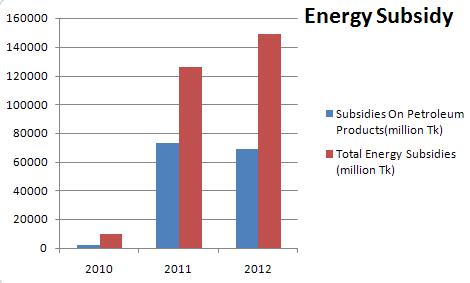
The above graph shows subsidies on petroleum products and total energy subsidies for 2010, 2011 and 2012. Two crucial ingredients for power generation are furnace oil and natural gas. Despite the fact that we imported more of these two petroleum products,we paid less because of the low oil price, as revealed by the following two graphs. An increase in oil price will lead to raise the furnace oil price and LNG price. As the price of oil crossing $100/barrel looms large, government may end up providing subsidies both to BPC and Petrobangla, increasing further total energy subsidies. A depreciation of Taka against dollar will further compound the situation requiring the government to pay more for the subsidies.


Bangladesh enjoyed a stable international oil market where oil was sold at below$50 per barrel in recent years.  Bangladesh Petroleum Corporation that distributes and markets petroleum goods made profits in this period and reached break even level in December last year, a thing none thought possible.It received huge amount of subsidies till 2015.After that it recorded profit due to low oil price, mostly below$50/barrel. As the domestic reserve of gas is depleting fast, the idea of LNG import came. Back then prices were lower due to stable oil market. Industrial units, power plants and fertilizer factories heavily hinge on natural gas. In order to ensure secure LNG supply, idea of import came to the policy planners' mind. Petrobangla that explores, manages and sells oil, gas and other minerals in the country purchases natural gas Tk 6 per cubic meter from domestic sources whereas imported LNG costs Tk 38 per cubic meter. Now it mixes locally procured gas with the imported one to cater to the need of domestic clients. Consequently, it will raise the price of natural gas for domestic users. Luckily  its LNG policy , just finalized, allows private importer to sell imported LNG to any client(industrial one) at bargained price and this "LNG Import Policy For Private Sector 2019" also assures that government will not intervene in fixing the price between the parties. Moreover, private importers will be able to sell imported LNG, not exceeding 25% of the total amount, to Petrobangla at a price set by Petrobangla. This kind of arrangements will relieve some of the pressures of Petrobangla. However, the contract of import and supply of LNG is awarded to some groups who are more closer to government. Now many fear in the absence of other competent players this private LNG contracts will look more like an extension of the permit raj scheme. There are groups who could form consortium to vie for this kind of business. Thereby ensuring more competition and choices to clients.

In the past we have seen good plans rendered useless due to corruption and governance failure. For instance, Gas Transmission Company Limited installed gas transmission line between Bheramara and Khulna. GTCL also set up a gas transmission line between  Haatikumrul and Bheramara. Both the projects cost thousands of crore Taka. According to GTCL, first project was completed in December 2015. And the second one a year later. When they were envisaged , it was anticipated that they would be connected to the national grid. That did not happen and no one knows when it will happen. It is just another " Khamba project", where electricity transmission polls were installed without increasing the production of electricity, that left a serious blot in BNP regime's reputation. The two said gas transmission lines not only swallowed taxpayer's money but represent a classic example how politically motivated and blessed projects are often doomed to fail, costing the economy a good chunk of hard-earned resources.

To obviate the uncertainties of energy supplies is what  prompted the government to import and supply LNG. Now it appears any volatility in the international market will increase the subsidy of the government to BPC and Petrobangla, opening up another cause of concerns since this kind of energy subsidy makes a heavy dent in other priority sectors. It is laudable that government encourages private companies to supply LNG at negotiated price. However transparency is needed to be ensured so that every one gets a fair chance to take advantage of Private LNG Import Policy. During the restricted phase of our economy, we witnessed emergence of permit raj/ license raj allowing a tiny privileged group to take larger share of economy hampering welfare  and pushing larger section of the population to vulnerabilities. Energy price affects everything. So Bangladesh just cannot afford to watch another phase of extended permit raj by allowing a tiny section in the vital energy market.