Showing posts with label LNG. Show all posts

Saturday, October 15, 2022

Energy Woe Deepens

Power cut invokes old memories
As oil price brings miseries.
Energy deal may not be sound
For few boots on the ground
As bad times may raise worries.

Dhaka has nowadays become city of frequent power cut. In my neighborhood, power cut at measured intervals sometimes lasts more than 2 hours. The situation is worse outside Dhaka,where power cut lasts more than 7 hours. This is the fallout of high oil price, stemming from the ongoing war in Ukraine. In addition, strong dollar complicated the problem by raising the import cost.Currently Bangladesh produces 12500 megawatts of electricity daily against the demand of 14500 megawatts. (Source: Daily Prothom Alo,Jalani Sonkot Berechhey,Sorboccho Load shedding(Energy Crisis Deepens,Power Cut Becomes Awful ),Mohiuddin Ahmed,P-1,October 11,2022).

Industrial production slowed down due to frequent power cuts.As fertilizer production gets top priority, LNG and subsidies go to produce food and fertilizer. Higher fuel cost also makes private power producers to slash their production.

LNG being the cheapest source of fuel has also been touched by the rising fuel price.Luckily, the price has come down to a tolerable level in international market,yet 57 powerplants have yet to see their production in full swing. Before the election of 2018,government inked deal with Qatar and Oman for long-term LNG supply. Being a substitute for oil ,LNG also witnessed unusual hike in its price following the volatile oil market. As more countries include LNG in their energy menu,LNG price shoots up. Qatar turned down Bangladesh’s urgent request of sending extra LNG. Instead the country stressed that it would consider such request after 2025.So our energy deals is not securing our energy needs.

Russia on the other hand has made it clear that it wants the repayment of Rooppur Nuclear Powerplant in ruble. It would further raise the cost of repayment as the payment has to be converted into several currencies(first yuan then to ruble). It is still undecided who will bear the extra charge for this multiple conversion.However, Russia is determined to complete the powerplant in time. When it will come into operation, it will tremendously help the irrigation system of Bangladesh. Currently, 4.215 million[*] hectares of land are irrigated by shallow and low-lift pumps(Source:BER 2019). These pumps intensively consume diesel. If we somehow manage to run the pumps with the electricity from nuclear power then we will save lots of money. This year alone,FY 2022-23,govt allotted Tk 83000 crores of subsidy,a large part of which will be spent on diesel and fertilizer subsidy. Previous year,govt spent TK 56000 crores on diesel and gas subsidy.

Significant part of our gas goes to electricity generation(40.80%). And the gas-run powerplants account for more than 55% of electricity. Continuous supply of gas could boost our electricity production and give our industry a competitive edge as gas is cheaper than diesel and furnace oil.

Our energy and food security should reflect our own interest. It should not be based on other’s whims or unreasonable demands. In the past,we witnessed how our energy deals flawed us in times of need. It is not wise to compromise our energy security by committing to send few boots on the ground and to comply demands of a tiny section of our society. Any energy deal should be based on pure economic terms and advantage our economy gains from such deal.Sweat and blood in exchange for few petrol dollars in a war that our people do not want is the least desirable thing in light of national interest. And such interest is well protected in the hands of the representatives who have people’s mandate to say the last words. Let the Parliament be the place to finalize such policies instead of closed door under-the-table deals that only doom the people and the country.

[Note: *This piece has been updated on October 21,2022 at 9:40 am Bangladesh Standard Time(BST)."42.15 hectares" is substituted with "4.215 million hectares".]
Thursday, July 4, 2019

Energy Security Or Shadow Of Permit Raj?

A recent report insinuates that Petrobangla incurs loss between Tk 620 and Tk 650 million daily for LNG import and its supply to national grid. The loss stemmed from the high global oil price. LNG prices vary in line with oil prices. Petrobangla imports LNG at prices between $8.5 metric million British Thermal unit (MMBtu) and $10 MMBtu. If things go like this then at the end of this year Petrobangla will lose TK 240 billion.

Petrobangla signed two sales and purchase agreements(SPA): one with the Ras Gas of Qatar and another one with Oman Trading International. To ensure smooth supply of LNG, Petrobangla allowed construction of two LNG terminals, also known as FSRUs, at Moheshkhali. One is owned by Excelerate Energy and the other is owned by Summit Group.

Petrobangla has already managed to bag Tk 10 billion subsidy for the current fiscal year in a bid to recuperate the loss due to price volatility. Earlier it had demanded Tk 5000 crore subsidy. It is anticipated that the loss may go up due to increase in LNG import and international market price.

Petrobangla's own projection shows that gas demand will continue to rise and so is the shortfall as the production and import will not catch up the demand. For instance, in 2021 gas demand will be 4520 metric million standard cubic foot per day (mmscfd) and production will be 2,414 mmscfd. There will be a shortfall of 2106 mmscfd. At the moment two LNG terminals , also known as FSRU, have the capacity to regasify 6 million tonnes of  imported LNG every year. Another land based FSRU will be installed. In 2017-2018, power and industry accounted for 40.78% and 16.51 % of total gas consumption.  Any price hike of fuel and gas in international market will increase the cost on subsidy and energy price, which will have a domino effect on everything. Now it seems Government has to provide subsidy to  both BPC and Petrobangla to make the prices of gas and oil stable at home.


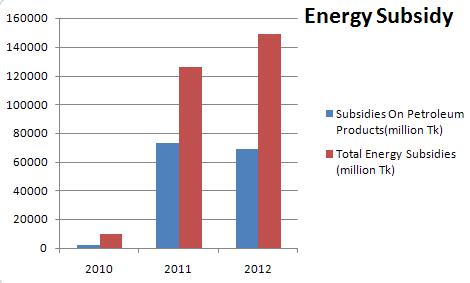
The above graph shows subsidies on petroleum products and total energy subsidies for 2010, 2011 and 2012. Two crucial ingredients for power generation are furnace oil and natural gas. Despite the fact that we imported more of these two petroleum products,we paid less because of the low oil price, as revealed by the following two graphs. An increase in oil price will lead to raise the furnace oil price and LNG price. As the price of oil crossing $100/barrel looms large, government may end up providing subsidies both to BPC and Petrobangla, increasing further total energy subsidies. A depreciation of Taka against dollar will further compound the situation requiring the government to pay more for the subsidies.


Bangladesh enjoyed a stable international oil market where oil was sold at below$50 per barrel in recent years.  Bangladesh Petroleum Corporation that distributes and markets petroleum goods made profits in this period and reached break even level in December last year, a thing none thought possible.It received huge amount of subsidies till 2015.After that it recorded profit due to low oil price, mostly below$50/barrel. As the domestic reserve of gas is depleting fast, the idea of LNG import came. Back then prices were lower due to stable oil market. Industrial units, power plants and fertilizer factories heavily hinge on natural gas. In order to ensure secure LNG supply, idea of import came to the policy planners' mind. Petrobangla that explores, manages and sells oil, gas and other minerals in the country purchases natural gas Tk 6 per cubic meter from domestic sources whereas imported LNG costs Tk 38 per cubic meter. Now it mixes locally procured gas with the imported one to cater to the need of domestic clients. Consequently, it will raise the price of natural gas for domestic users. Luckily  its LNG policy , just finalized, allows private importer to sell imported LNG to any client(industrial one) at bargained price and this "LNG Import Policy For Private Sector 2019" also assures that government will not intervene in fixing the price between the parties. Moreover, private importers will be able to sell imported LNG, not exceeding 25% of the total amount, to Petrobangla at a price set by Petrobangla. This kind of arrangements will relieve some of the pressures of Petrobangla. However, the contract of import and supply of LNG is awarded to some groups who are more closer to government. Now many fear in the absence of other competent players this private LNG contracts will look more like an extension of the permit raj scheme. There are groups who could form consortium to vie for this kind of business. Thereby ensuring more competition and choices to clients.

In the past we have seen good plans rendered useless due to corruption and governance failure. For instance, Gas Transmission Company Limited installed gas transmission line between Bheramara and Khulna. GTCL also set up a gas transmission line between  Haatikumrul and Bheramara. Both the projects cost thousands of crore Taka. According to GTCL, first project was completed in December 2015. And the second one a year later. When they were envisaged , it was anticipated that they would be connected to the national grid. That did not happen and no one knows when it will happen. It is just another " Khamba project", where electricity transmission polls were installed without increasing the production of electricity, that left a serious blot in BNP regime's reputation. The two said gas transmission lines not only swallowed taxpayer's money but represent a classic example how politically motivated and blessed projects are often doomed to fail, costing the economy a good chunk of hard-earned resources.

To obviate the uncertainties of energy supplies is what  prompted the government to import and supply LNG. Now it appears any volatility in the international market will increase the subsidy of the government to BPC and Petrobangla, opening up another cause of concerns since this kind of energy subsidy makes a heavy dent in other priority sectors. It is laudable that government encourages private companies to supply LNG at negotiated price. However transparency is needed to be ensured so that every one gets a fair chance to take advantage of Private LNG Import Policy. During the restricted phase of our economy, we witnessed emergence of permit raj/ license raj allowing a tiny privileged group to take larger share of economy hampering welfare  and pushing larger section of the population to vulnerabilities. Energy price affects everything. So Bangladesh just cannot afford to watch another phase of extended permit raj by allowing a tiny section in the vital energy market.