Showing posts with label Petrobangla. Show all posts

Monday, February 22, 2021

LNG Blunder

Disagreement between PetroBangla and ministry
Unravels the flaws in LNG policy.
Energy deals offer clue of corruption,
Eschewing that questions docu's true intention.

Recent news reports reveal some problems within government's LNG policy. It has not been a long time that Bangladesh embarked on LNG age. Two years ago Bangladesh received its first LNG supply after completing appropriate infrastructure. Recently Ministry of Finance asked PetroBangla to send its unused Tk 40 billion to the government as part of a new policy. PetroBangla declined. Instead, it demanded Tk10.94 billion to finance the operations of two floating storage units , operated by Exelerate and Summit, citing volatile nature of the LNG market. Government refused to pay the sum.

Last week government inked a deal with Vitol Asia, a subsidiary of Dutch Vitol. According to a news report, the company has been blacklisted in several countries. On many occasions, the company was found to win government contract through unfair means. It is not yet known how the company bagged the contract of supplying two cargoes of LNG from the spot market. Earlier government had signed several contracts for long term LNG supply. Qatar's Ras Laffan Liquefied Natural Gas Company is one of them. It pledged to supply between 1.8 and 2.5 MTPA of natural gas for 15 years.The deal was signed in September 2017.

LNG is a cheap mean for power generation. As demand for LNG is rising , government has opted for LNG import to produce electricity, to produce fertilizer and industrial good. Stat furnished by PetroBangla reveals that demand for natural gas is projected to be 3463 MMCFD in 2021 and 3554 MMCFD in 2025 (Source: Bangladesh Economic Review 2019). A large part of this demand will go for power generation. A news report claims power generation using natural gas costs Tk 4 per unit. Meanwhile, power generation using diesel costs Tk 22 per unit. Cheaper electricity means lower production cost, more concentration on product quality and grabbing more market share. In 2013-14, 337.4 billion cubic foot of natural gas was used in power generation. In 2017-18, it rose to 398.6 billion cubic foot (Source: BER 2019).

Growing importance of LNG led the government to build LNG infrastructure. Two floating storage and regasification units were installed in Moheskhali. One of them operated by a company having close ties with a ruling party leader. Seeking money for their operations clearly aroused suspicions. In Bangladesh such business and operations are not scam free.

By the same token, there is little reason to believe that just concluded deal with Vitol Asia is not free of any murky affair. It is interesting to see the reaction of the Finance minister when Vitol's past was brought to his attention. He played ignorant about wrongdoings of Vitol Asia in other countries and kept insisting that the deal was struck in a fair and transparent manner.

The September 2017 deal RasGas made with Bangladesh took place at a time when the government lacked international recognition due to its opposition-boycotted election,heavily criticized at home and abroad. The nittty-gritty of the deal is also not known to public. How was the pricing of LNG gas fixed?Such deal could contain ample ammunition of corruption that could draw a widespread media attention. Access to those critical information is kept within the party cronies and government officials. The controversial 2018 general election shed some light. BBC World was more outspoken and open in revealing election irregularities like stuffed ballot-box at the beginning of election day at a polling center in Chattogram and severe beating of a reporter in Shewrapara in Dhaka. Reelection did take place in Chattogram polling center but no action taken against the men who beaten the reporter. Al Jazeera did report on election fraud but it was not as open as its British counterpart.

This kind of energy deal is the allegation weapon that has the potential to disturb a government and the information is readily available to Al Jazeera. Is it because that the deal happened between government-to-government and it could harm the reputation of both governments , so better remained silent?

Focusing on settling down of personal scores that only establishes the credible threat protagonists face at home hardly unsettles any ruling regime.

Our opaque energy and power deals offer many hints of corruption, as no saint involved in such deals.

It is hard to believe that government did not reckon with need of sudden demand of fund to purchase LNG when the LNG plan was conceived. Projection was there, contract was there. And it is neither believable that a public corporation lying on Tk 40 billion of excess fund suddenly needs fund to finance the operations of two floating storage units. Making deals with companies with less transparent business only puts question marks on gov't intention. Responsibility lies with the concerned section of the government to douse the suspicion of unfair means.
Thursday, July 4, 2019

Energy Security Or Shadow Of Permit Raj?

A recent report insinuates that Petrobangla incurs loss between Tk 620 and Tk 650 million daily for LNG import and its supply to national grid. The loss stemmed from the high global oil price. LNG prices vary in line with oil prices. Petrobangla imports LNG at prices between $8.5 metric million British Thermal unit (MMBtu) and $10 MMBtu. If things go like this then at the end of this year Petrobangla will lose TK 240 billion.

Petrobangla signed two sales and purchase agreements(SPA): one with the Ras Gas of Qatar and another one with Oman Trading International. To ensure smooth supply of LNG, Petrobangla allowed construction of two LNG terminals, also known as FSRUs, at Moheshkhali. One is owned by Excelerate Energy and the other is owned by Summit Group.

Petrobangla has already managed to bag Tk 10 billion subsidy for the current fiscal year in a bid to recuperate the loss due to price volatility. Earlier it had demanded Tk 5000 crore subsidy. It is anticipated that the loss may go up due to increase in LNG import and international market price.

Petrobangla's own projection shows that gas demand will continue to rise and so is the shortfall as the production and import will not catch up the demand. For instance, in 2021 gas demand will be 4520 metric million standard cubic foot per day (mmscfd) and production will be 2,414 mmscfd. There will be a shortfall of 2106 mmscfd. At the moment two LNG terminals , also known as FSRU, have the capacity to regasify 6 million tonnes of  imported LNG every year. Another land based FSRU will be installed. In 2017-2018, power and industry accounted for 40.78% and 16.51 % of total gas consumption.  Any price hike of fuel and gas in international market will increase the cost on subsidy and energy price, which will have a domino effect on everything. Now it seems Government has to provide subsidy to  both BPC and Petrobangla to make the prices of gas and oil stable at home.


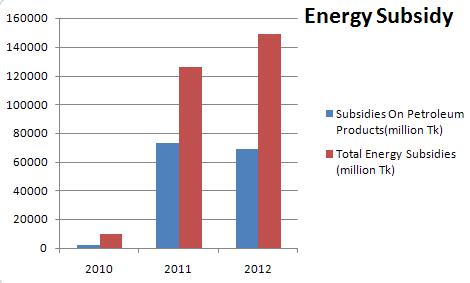
The above graph shows subsidies on petroleum products and total energy subsidies for 2010, 2011 and 2012. Two crucial ingredients for power generation are furnace oil and natural gas. Despite the fact that we imported more of these two petroleum products,we paid less because of the low oil price, as revealed by the following two graphs. An increase in oil price will lead to raise the furnace oil price and LNG price. As the price of oil crossing $100/barrel looms large, government may end up providing subsidies both to BPC and Petrobangla, increasing further total energy subsidies. A depreciation of Taka against dollar will further compound the situation requiring the government to pay more for the subsidies.


Bangladesh enjoyed a stable international oil market where oil was sold at below$50 per barrel in recent years.  Bangladesh Petroleum Corporation that distributes and markets petroleum goods made profits in this period and reached break even level in December last year, a thing none thought possible.It received huge amount of subsidies till 2015.After that it recorded profit due to low oil price, mostly below$50/barrel. As the domestic reserve of gas is depleting fast, the idea of LNG import came. Back then prices were lower due to stable oil market. Industrial units, power plants and fertilizer factories heavily hinge on natural gas. In order to ensure secure LNG supply, idea of import came to the policy planners' mind. Petrobangla that explores, manages and sells oil, gas and other minerals in the country purchases natural gas Tk 6 per cubic meter from domestic sources whereas imported LNG costs Tk 38 per cubic meter. Now it mixes locally procured gas with the imported one to cater to the need of domestic clients. Consequently, it will raise the price of natural gas for domestic users. Luckily  its LNG policy , just finalized, allows private importer to sell imported LNG to any client(industrial one) at bargained price and this "LNG Import Policy For Private Sector 2019" also assures that government will not intervene in fixing the price between the parties. Moreover, private importers will be able to sell imported LNG, not exceeding 25% of the total amount, to Petrobangla at a price set by Petrobangla. This kind of arrangements will relieve some of the pressures of Petrobangla. However, the contract of import and supply of LNG is awarded to some groups who are more closer to government. Now many fear in the absence of other competent players this private LNG contracts will look more like an extension of the permit raj scheme. There are groups who could form consortium to vie for this kind of business. Thereby ensuring more competition and choices to clients.

In the past we have seen good plans rendered useless due to corruption and governance failure. For instance, Gas Transmission Company Limited installed gas transmission line between Bheramara and Khulna. GTCL also set up a gas transmission line between  Haatikumrul and Bheramara. Both the projects cost thousands of crore Taka. According to GTCL, first project was completed in December 2015. And the second one a year later. When they were envisaged , it was anticipated that they would be connected to the national grid. That did not happen and no one knows when it will happen. It is just another " Khamba project", where electricity transmission polls were installed without increasing the production of electricity, that left a serious blot in BNP regime's reputation. The two said gas transmission lines not only swallowed taxpayer's money but represent a classic example how politically motivated and blessed projects are often doomed to fail, costing the economy a good chunk of hard-earned resources.

To obviate the uncertainties of energy supplies is what  prompted the government to import and supply LNG. Now it appears any volatility in the international market will increase the subsidy of the government to BPC and Petrobangla, opening up another cause of concerns since this kind of energy subsidy makes a heavy dent in other priority sectors. It is laudable that government encourages private companies to supply LNG at negotiated price. However transparency is needed to be ensured so that every one gets a fair chance to take advantage of Private LNG Import Policy. During the restricted phase of our economy, we witnessed emergence of permit raj/ license raj allowing a tiny privileged group to take larger share of economy hampering welfare  and pushing larger section of the population to vulnerabilities. Energy price affects everything. So Bangladesh just cannot afford to watch another phase of extended permit raj by allowing a tiny section in the vital energy market.